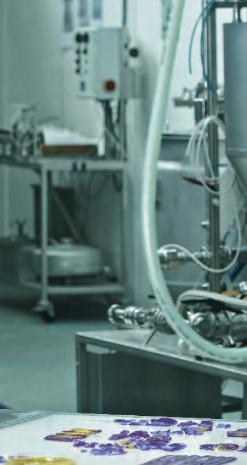
how many varieties of sliced sausage or cheese you find ready
packed and with a long shelf life. These foods need to be
processed under very hygienic conditions. This requires new
approaches to create systems which can be cleaned more easily
and reliably. Hygienic design is also of interest in cases where
production plants are no longer used for just one type of food.
Given today’s variety of products, it is important that machines
are able to handle different recipes with the associated cleaning
between product types. This means that once again the
emphasis is on cleanability, saving time and avoiding the danger
of cross contamination.
What are you currently working on?
Hofmann:
Very many different things. Firstly, we are expanding
our range of training products and services still further to meet
the wide ranging requirements of the industry. Secondly, I am
trying to make large events such as HygieniCon even more
attractive to exhibitors and visitors. On the research side, we are
working with the Technical University of Munich to develop new
test methods to check cleanability and study the interaction of
dirt particles with various surfaces. And of course I have a
special interest in training the next generation of engineers and
technicians at universities and technical colleagues.
On a personal level: who or what inspires you in your work?
Hofmann:
Above all variety. Hygienic design is interesting in all
industries and gives me an insight into the various processes
and operations. The frequent successes we achieve mean that
there is no danger of losing motivation. Production plants are
producing food more safely and designers are developing
excellent, easy-to-clean components.
And finally, a question about your private life. What do you
enjoy doing in your leisure time?
Hofmann:
In the little spare time which I have outside of work,
I like to go into the mountains for hiking or skiing and try
whenever possible to discover more of the world.
¢
Hygienic Design Weihenstephan
Research, teaching and consultancy
Hygienic Design Weihenstephan is
made up of the Hygienic Design
Institute, an Academy and a Consulting
service, with participation by partners
from the fields of research, industry
and the media. The Hygienic Design
Institute conducts all the research
activities of the TU Munich at the
Weihenstephan campus in the field of
hygienic design and includes the
EHEDG test laboratory. In cooperation
with industry, institutes and
organisations, the Hygienic Design
Academy organises conferences and
seminars on the topics of legislation,
hygienic engineering, product safety,
production room technology,
cleanliness, microbiology, efficiency
and quality assurance. The third area,
Hygienic Design Consulting, provides
internal company training and
assesses the ease of cleaning of
components and systems.
European Hygienic Engineering & Design Group
EHEDG
The European Hygienic Engineering &
Design Group is a consortium of
research institutes, food
manufacturers, machine and
installation builders and health
authorities. It was founded in 1989 in
order to bring about continuous
improvement in hygienic engineering
and hygienic design. Its aim is safety in
the processing and packaging of food.
The consortium actively supports
European legislation, which states that
the handling, processing and
packaging of food must meet various
hygiene requirements. This is to be
ensured by using hygienic machines
and installations and hygienic
premises which conform to the EU
Directive 2006/42/EC for machines
and installations and the hygiene
requirements of the European
standards EN 1672-2 and EN ISO
14159.
www.ehedg.de
trends in automation
Inspiration
8
–
9