Skills Analysis
For any business to maximise the results
of automation you need to know if your
people have the right skills and
knowledge to operate in a different
environment.
Conducting a skills and need analysis will
help avoid two common mistakes in an
automation project. The first is over
specification where your organisation
ends up with machinery that costs too
much and there might not be the skills
internally to operate and maintain it. The
second is under specification where the
promised outputs aren’t being achieved.
Both are equally damaging. Engaging
employees in the design and specification
of the machinery will lead to appropriate
automation where the complexity of the
machinery is compatible with the skills
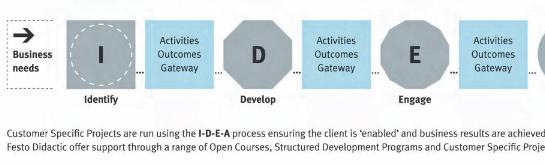
available. In Festo we use a simple four
step methodology to understand the
needs and skills available called the
IDEA
process.
The first step is to
identify
the needs of
the organisation. This process must
include those at a senior level, those who
will be driving the project, and
importantly those who will be
participating in the project – including the
machine builders and employees who will
be operating the machinery once it is
delivered and installed.
This stage identifies the business and
personal needs of each group and
highlights any training needs. For
example, does the team have the
necessary skills to operate the
machinery? Are there the skills internally
to maintain and repair the machinery in
the long term?
By identifying these needs early on in the
project, training can be incorporated at
every stage. For example production staff
can work side by side with the machine
builders to understand the equipment
literally inside out.
The second step is to
develop
tools such
as designing a project plan complete with
project tools and timescales. The next
step is
engagement
, which we’ve already
discussed earlier.
The final step is to
apply
the skills and
knowledge learnt through training and
development. Employees return to the
working environment and encounter
reality. Research suggests that as much
as 50% of acquired knowledge can be lost
within a few weeks if there is no
opportunity to use it. Skills need to be
applied and practiced as soon as
possible. Even then new situations and
questions will arise. These can be
handled through coaching, clinics and
workshops so that the project is regularly
measured against the defined KPIs.
Through correct skills and needs
identification, employees are equipped to
deliver the hoped for business benefits.
There is also a strong personal benefit