Basic HTML Version


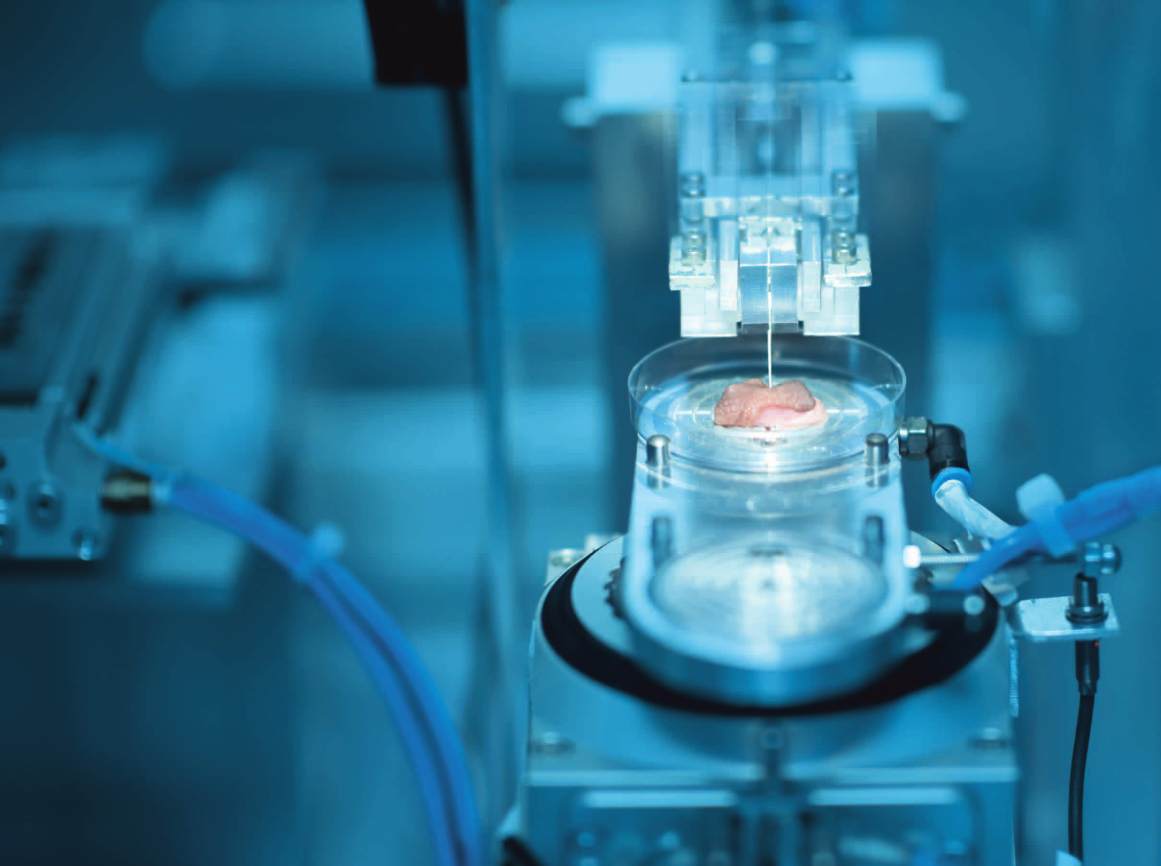
T
he skin is the most important
organ in the human body. The
production of tissue models
for testing medical treatments
is therefore very complex. Until now,
skin equivalents for transplants or for
verifying the compatibility of active
ingredients in medicines, cosmetics and
chemicals were only produced manually
on a laboratory scale. Culturing took
a whole six weeks. Using this method,
it was generally not possible to produce
more than 2,000 pieces of skin per
month, each measuring a square centi-
metre. This is certainly not the case in
the new “Tissue Factory” at the BioPoLiS
bioproduction laboratory of Fraunhofer
IPA. It is the world’s first facility with fully
automated in vitro production, producing
up to 5,000 thumbnail-sized skin models
per month.
Seamless automation
The facility for the production of skin
equivalents is a flagship project in the
area of bioproduction, which is the sym-
biosis of biology and automation tech-
nology. The interdisciplinary cooperation
between biologists and engineers led to
an unprecedented degree of automation
in tissue engineering. The seamless auto-
mation of all process steps facilitated
the introduction of new production and
financial standards such as reproducible
quality, throughput and cost optimisa-
tion in skin model construction.
Faster production
To produce around 5,000 skin models
per month, biological requirements with
regard to the sterility of all processes
and the handling of cells must be met.
This involves a multi-stage process
in which the skin samples are first
sterilised, transported to the system by
robot, broken down, isolated and culti-
vated in a special culture medium under
constant ambient conditions. The cells
are then grown in a 3D gel matrix in two
layers. The skin equivalent is ready for
use after just three weeks. In accordance
with the principles of hygienic design,
the developers of the tissue factory
aimed for a continuous process chain.
Cell extraction and proliferation as well
as three dimensional tissue formation
are carried out in a seamless sequence
in a single system. The process incorpo-
rates more than 100 Festo components,
including compressed air preparation,
sensors, cylinders, electric axes, servo
and stepper motors as well as fast-
switching valves and the valve series
VUVG. The majority of these compo-
nents are found in the cell extraction
process. Where the products are part
of the production space, clean room
components are used. The decapper
operates as a complete system and is
responsible for unscrewing lids.
Future-proof
The bioproduction of tissue engineering
products is already a hugely important
area in biotechnology. It allows tissue to
be produced in larger quantities and thus
represents a major step forward in cell
research. This new technology paves the
way for an end to animal testing of prod-
ucts to check the skin tolerance level.
In regenerative medicine, skin equivalents
are helping an increasing number of peo-
ple, for example with wounds that are
not healing properly. In future, scientists