Basic HTML Version


Tooth by tooth
Modern transmissions for cars and commercial vehicles
must be able to withstand extreme loads and at the same
time run quietly. This applies in particular to the spiral bevel
gears used in drive systems, which must redirect the torque
from the drive shaft by 90° to the axle shafts. In modern
production machines, ready-to-install pneumatics from
Festo deliver increased safety and shorter assembly times.
Milling of bevel gears
H
igh-quality spiral-cut bevel gears
combine maximum load capacity
with a low noise level and a high
degree of eff iciency. Like many
components in the automotive industry,
they are subject to demands for reduced
weight combined with the smallest possi-
ble dimensions. Ever smaller bevel gears
must guarantee the low-noise transmis-
sion of ever larger torques over hundreds
of thousands of kilometres. Specialists
in the area of bevel gear machine build-
ing like Klingelnberg GmbH depend on
sophisticated production processes in
order to guarantee maximum precision
of the processing machine.
Smooth processes
The manufacturing process in machines
for bevel gear production begins with the
setup process for the clamping device
and the tool as well as the setup of auto-
matic workpiece loading. The bevel gears
are milled using cutter heads, which cut
out the tooth gaps in the dry-cutting
process. The bevel gears are then hard-
ened and ground flat and rounded. The
hard tooth flanks are ground or lapped
depending on their purpose. Two hard
finishing processes give the tooth flanks
the properties needed for a long service
life, low noise and energy efficiency.
Large parts of the systems, which can
be as big as a bus, are operated and con-
trolled pneumatically at 6 bar. Time plays
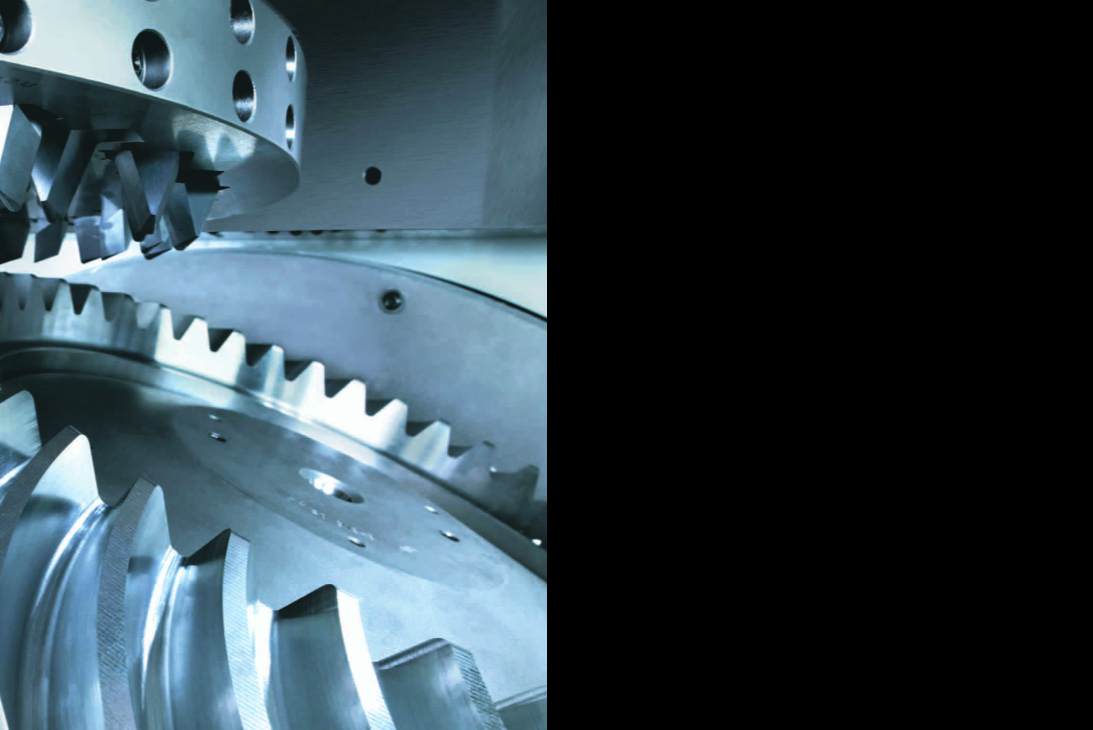
Tool and product:
Cutter head with
spiral-cut bevel gear.