Biotechnology refers to the technical use of biological systems, cells, or organisms for the development of products and processes. It combines disciplines such as biology, chemistry, process engineering and automation. The goal is to control and monitor biological processes in a targeted way and to transfer them into stable, reproducible processes.
Biotechnological applications range from laboratory operations to continuous, industrial production processes. The technical implementation plays a key role in determining whether a biological process can be scaled and operated economically.
Biotechnological processes are now used in a wide variety of industries and represent core applications of biotechnology across different sectors. In the pharmaceutical and biopharmaceutical industries, they form the foundation for the production of complex active ingredients and vaccines, as well as cell and gene therapies. In industrial biotechnology, biological processes are used, for example, in fermentations or enzymatic conversions.
The food‑ and beverage industry are also increasingly using biotechnology for process optimisation or the development of new products. Moreover, it is gaining importance in the fields of energy and the environment, for instance in sustainable reservoir and conversion concepts. Despite different objectives, these applications are united by the high demand for technical precision and process stability.
The increasing importance of biotechnology is closely linked to global developments and the pursuit of sustainable growth. The need for sustainable production methods is growing, as is the demand for bio-based and personalised products. At the same time, biotechnological processes must be transferred more quickly from research to industrial-scale production.
This scaling process brings new technical challenges. Manual processes quickly reach their limits, whereas automated systems enable reproducible conditions and consistent process quality. That means automation becomes the central enabler of modern biotechnology.
Biotechnological applications place special demands on system engineering and automation. Process parameters such as temperature, pressure, media flow, and gas composition must be precisely controlled and continuously monitored. At the same time, hygienic designs and sterilisable components are essential to protect sensitive biological systems.
In addition, there is a need for flexible and modular system concepts. Processes must be adaptable to different development stages: from lab tests to the production plant. A seamless automation strategy ensures consistent transfer and scaling of processes.
Festo supports biotechnological applications with a portfolio specifically tailored to the technical requirements of biological processes. The focus is on the connection of automation, process-oriented hardware and sound engineering‑know‑how.
In addition, Festo is actively involved in the research of future technologies. In the frame of innovation projects, biological principles are analysed and transferred to technical applications. Examples of this are the PhotoBionicCell and the BionicHydrogenBattery, which demonstrate how biological processes can be utilised for new approaches to energy, resource utilisation, and system design. These research projects provide important impetus for advancing biotechnological applications and emphasise the ambition to connect innovation with industrial practice.
PhotoBionicCell
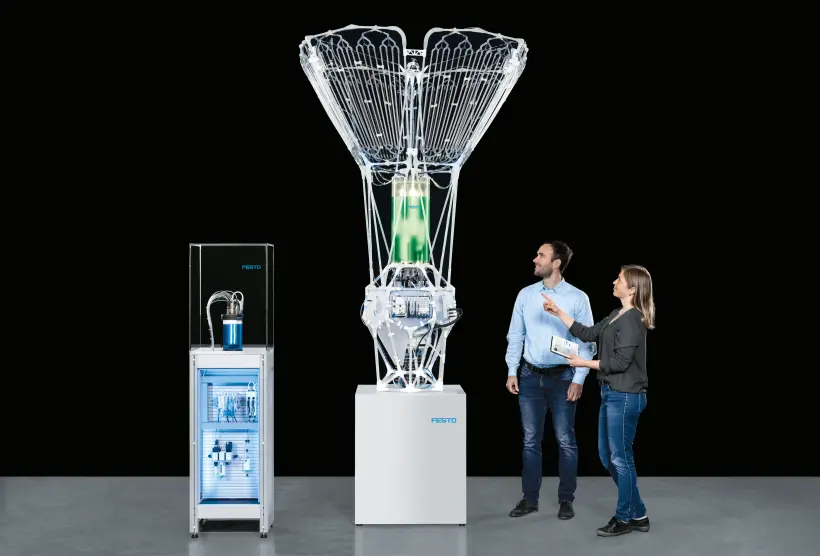
The PhotoBionicCell demonstrates how biological processes can be combined with modern controller and closed-loop control technology. It serves as an example of the approach to making biological reactions technically controllable, unlocking new biotechnological applications.
BionicHydrogenBattery
With the BionicHydrogenBattery, Festo leverages biological functional principles in the context of sustainable energy systems. This solution demonstrates how biotechnology‑based concepts for energy generation and storage can be technically implemented and integrated into overarching systems.
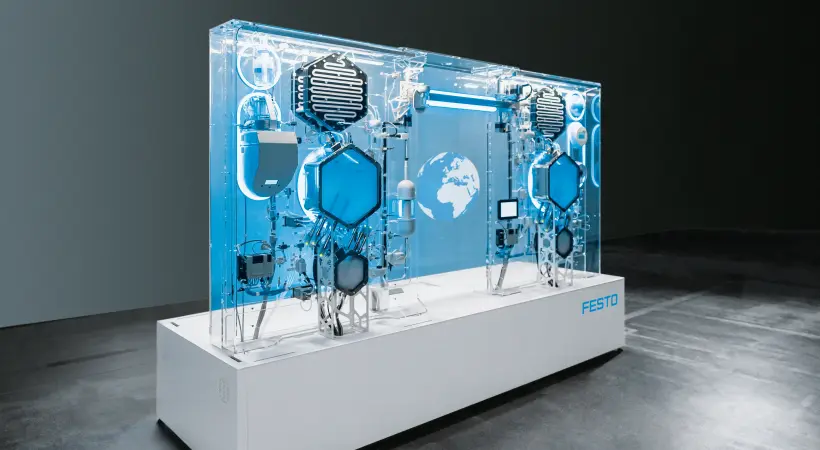
The listed examples are representative of Festo's biotechnology portfolio. In addition, Festo supports biotechnological applications throughout the entire process: from individual automation components to holistic engineering and system solutions. Biological, process-related and technical requirements are brought together in a targeted manner.
Since biotechnological projects are individual, direct professional exchange is crucial. Festo supports users in analysing their specific requirements and in the development of tailored technical solutions for their respective project needs.
Biotechnology is a key technology for numerous industries and will continue to gain in importance. The success of biotechnological processes depends significantly on precise, reliable and scalable technical implementation.
Festo combines automation expertise with deep process understanding and supports businesses in efficient and future-proof execution of biological processes from the laboratory to industrial applications.