充滿變化與複雜性的職場正等待著您的畢業生。

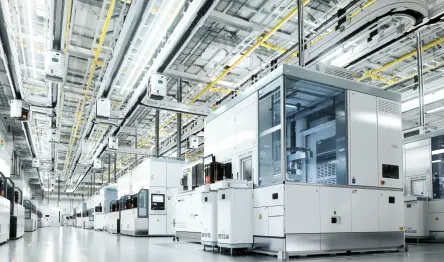
半導體是在被稱為晶圓廠或代工廠的專門生產設施中製造的。 這些高科技工廠在可控的無塵室環境中運行,利用先進的設備和工業自動化來執行複雜、專業的流程,並採取嚴格的品質控制措施。

半導體產業競爭激烈,技術發展迅速,產品生命週期短。 公司面臨巨大的壓力,需要迅速將新產品推向市場,同時維持品質和性能標準。 提高產量和實現高產量(晶圓上無瑕疵晶片的百分比)極為重要。

這就是為什麼半導體公司不斷投資新設備和製程優化以保持競爭力的原因。 這需要一支能夠適應不斷變化的工作場所的高技能勞動力,這也解釋了為什麼公司大力投資新員工入職培訓和持續的員工發展計畫。

您的課程是否有效地幫助畢業生做好迎接未來挑戰的準備?
半導體: 晶圓的特寫

自動化是製造過程的催化劑。

了解主要生產步驟和相關設備和工具可以揭示半導體製造的複雜性。 工業自動化在生產中發揮重要作用,因為這些製造過程需要奈米級的高精度、高速度和高產量。

晶圓製造

一切都始於高純度矽錠,通常在專門的製造工廠使用稱為 Czochralski 法的製程生產,然後出售給半導體代工廠和晶圓廠。

在晶圓製造過程中,矽錠被切成薄而圓形的晶圓。 然後對這些晶片進行拋光,以形成光滑的表面。 晶圓鋸切機用於切割矽錠,研磨機和拋光機用於拋光晶圓。

氧化

矽片表面生長一層薄薄的二氧化矽。 該層起到絕緣層的作用,有助於製造過程的後續程序。 這是使用稱為氧化爐的特殊爐子來完成。

微影

此步驟定義晶圓上的電路佈局。 將一種稱為光阻的感光材料塗在晶圓上,然後使用稱為微影步進機的特殊機器將圖案投射到晶圓上。 這台機器的工作原理類似於投影儀,但控制非常精確。 使用光罩對準系統來確保精度和一致性。

蝕刻

透過選擇性蝕刻,根據圖案化的光阻從晶圓表面去除材料。 此步驟定義了半導體裝置的特性。 蝕刻機有不同的類型:使用化學溶液的濕式蝕刻機或使用氣體或等離子的乾式蝕刻機。

在晶圓的每一層上重複微影和蝕刻製程。

沉積和摻雜

沉積是在晶圓表面添加薄層材料來建構電路並建立所需的特徵。 化學氣相沉積 (CVD) 系統將前驅氣體引入反應室,在那裡反應形成薄膜。 物理氣相沉積 (PVD) 系統使用物理方法(例如蒸發或濺鍍)將材料沉積到晶圓表面。

在摻雜階段,將雜質引入半導體材料以改變其電特性。 離子植入是一種常見的摻雜方法。 離子植入機將離子加速植入晶圓表面,以在特定深度植入摻雜劑。 擴散爐在摻雜氣體的條件下加熱晶圓,使摻雜物擴散到半導體材料中。

金屬佈線

此步驟也稱為金屬化,涉及在晶圓上添加金屬層以連接電路的不同組件並提供電流流動的路徑。 這是使用類似於沉積中使用的沉積系統來完成的。 一旦金屬沉積,就使用微影技術對其進行圖案化以形成電線。

電容器、電晶體、電阻器和二極體等電子元件可以在製造過程的各個步驟中整合到半導體裝置中,具體取決於所製造的半導體裝置的類型。

封裝和測試

半導體裝置經過分離、封裝和測試,以確保其功能性和可靠性。 晶片鍵合機將單一晶片附著在封裝基板上,打線機將晶片連接到封裝引線,封裝設備將晶片密封在保護材料中,測試系統執行電氣測試以驗證設備性能。 電化學晶片分選 (EDS) 機用於測試每個晶片的電氣特性並根據其性能進行分選。

Do your training programs cover all the skills requirements?

Our learning programs equip graduates with a sound, multifaceted expertise. There is a wide array of high-tech equipment and systems to efficiently commission, operate, service, troubleshoot and repair. This solid understanding of fundamental technologies and principles ensures they transition smoothly into the industry during integration programs with their employer.

Semiconductor fundamentals

An onboarding program for new hires in the semiconductor manufacturing industry should cover essential topics to provide a comprehensive understanding of the fundamentals and the manufacturing processes of semiconductors.

An introduction to semiconductor physics, including concepts such as band theory, doping, and carrier mobility, and a review of the semiconductor industry's value chain set the stage. Next, an overview of semiconductor materials, device structures, and device characteristics helps new hires grasp the basics.

Moving on, an exploration of semiconductor manufacturing processes, including photolithography, etching, deposition, and packaging, provides insight into the intricacies of production. An introduction to the operation and maintenance of manufacturing equipment, as well as metrology tools, to build familiarity with the essential tools of the trade.

Cleanroom protocol and safety standards are crucial to ensure contamination control and workplace safety. Quality control principles and data analysis techniques round out the program, emphasizing the importance of product quality and process optimization.

By focusing on these main topics, new hires gain a solid understanding of semiconductor manufacturing, ready to achieve success in the industry.

Factory automation

Semiconductor manufacturing is characterized by digitalization, since it forms the basis for Industry 4.0 technologies such as the Industrial Internet of Things (IIoT), cyber-physical systems, additive manufacturing, augmented reality (AR), virtual reality (VR), artificial intelligence (AI), big data analytics, and other advanced innovations. In this context, the digitalization of factory automation technologies optimizes production processes and enhances operational efficiency

Mechatronics, a multidisciplinary field combining mechanical, electrical, and computer engineering, is essential for understanding and maintaining the complex machinery and robotic systems utilized in semiconductor production. Furthermore, as manufacturing facilities move toward interconnected production lines, operators need expertise in networking technologies to ensure seamless communication and coordination between equipment and systems. MES platforms play a pivotal role in optimizing production processes, scheduling, and resource allocation, requiring operators to be proficient in their operation and utilization.

Additionally, with an ever greater focus on  energy efficiency, employees must have knowledge of energy management principles, particularly in areas such as electrical systems and compressed air usage, to minimize energy consumption and reduce the environmental impact of semiconductor manufacturing facilities.

Industrial and mobile robotics

Robots, both industrial and mobile, have become integral components of the modern fab environment.

Industrial robots handle silicon wafers throughout the manufacturing process. They are used in semiconductor assembly and packaging operations to pick and place components with high precision. Industrial robots assist in etching and deposition processes by precisely positioning substrates and masks in process chambers. They can be found in metrology and inspection, and even cleanroom maintenance. Depending on the task, various robots are used, such as articulated, cartesian, collaborative (cobots), and others.

Autonomous or semi-autonomous mobile robots are also used for material handling (transporting materials, components, or finished products between different areas of the manufacturing facility), inventory management (tracking and locating semiconductor wafers, components, or tools) and inspection tasks.

Programmable logic controllers (PLCs)

PLCs are widely used in semiconductor manufacturing systems to control and coordinate various processes. Proficiency in PLC skills is essential for individuals working in industrial automation, manufacturing, and process control, enabling them to effectively program, operate, and maintain PLCs to optimize production processes and ensure the smooth operation of industrial machinery.

Understanding PLC hardware components is essential for selecting, installing, configuring, and troubleshooting PLC systems. Proficiency in PLC programming languages is vital for developing, testing, and debugging PLC programs using professional programming software. Additionally, integrating safety features into PLC programs, such as emergency stop circuits, interlocks, and safety-rated relays, is crucial.

Since PLCs are often integrated in an industrial network, technicians must also know how PLCs interface with various manufacturing equipment and systems in semiconductor fabs. This includes understanding sensor technologies, actuator types, communication protocols, and data exchange mechanisms used to integrate PLCs with equipment such as robots, vacuum chambers, chemical delivery systems, and metrology tools. Configuration of PLC communication interfaces, setup of network connections, and troubleshooting communication issues require a solid understanding of industrial communication protocols.

Furthermore, employees should be capable of collecting, processing, and analyzing data generated by the PLCs to monitor process performance, identify deviations, and optimize production processes.

Electrical technology

Electrical systems play a vital role in powering up, controlling, and monitoring semiconductor manufacturing equipment and processes.

All technicians need a solid understanding of the basics of electrical engineering and electronics, such as electrical principles, including voltage, current, resistance, power, and circuits. Training on electrical safety practices, including lockout/tagout procedures, proper use of personal protective equipment (PPE), and precautions for working with high voltage equipment is paramount.

Electric motors are widely used in machines and systems in semiconductor manufacturing since they are efficient, precise, and reliable. Their ability to deliver a consistent performance, coupled with low maintenance requirements, makes electric motors a preferred choice for powering critical devices such as robotic arms, conveyor systems, vacuum pumps, and wafer handling systems in semiconductor manufacturing plants.

Electric motor controllers provide efficiency, precision, reliability, and safety across production processes. Their speed, torque, direction, and position can be regulated using basic technologies such as relays, stepper and servo drives, variable-frequency drives, PLCs. etc.

Electronics skills are indispensable for the semiconductor manufacturing workforce, as it enables them to grasp the underlying principles of semiconductor technology, optimize manufacturing processes, operate sophisticated equipment, and troubleshoot and repair, even circuit boards. Proficiency in circuit theory, power electronics, analog electronics, and digital electronics is particularly relevant in semiconductor manufacturing, where intricate electronic components and systems are used in production equipment.

Pneumatics

Pneumatic and electropneumatic components are commonly used in semiconductor manufacturing equipment for various purposes, including actuation, control, and manipulation. Vacuum technology ensures wafers are aligned and stable during photolithography and etching processes. Pneumatic pumps and valves ensure gases and chemicals are supplied precisely and consistently.

Given the need for high precision, complex automation, and data-driven optimization in semiconductor manufacturing, digital pneumatics—pneumatic components equipped with digital control technology—offers enhanced functionality, precise control, and communication capabilities.

These technologies enable cost-effective, high-performance solutions with rapid response times, simple installation and maintenance, cleanliness, and adaptability. Additionally, pneumatic systems are non-sparking and intrinsically safe, making them suitable for use in hazardous environments commonly found in semiconductor manufacturing facilities.

Sensor technology

Sensors play a critical role in monitoring, controlling, and optimizing various processes, equipment, and environments to ensure the production of high-quality semiconductors. Sensors monitor temperature, pressure, flow, level, optical properties, vibration, position, among others, providing real-time feedback on process conditions. This enables operators to maintain optimal parameters and promptly detect any deviations that could impact product quality.

In recent years, smart sensors and their seamless integration into industrial control systems have elevated automation to new levels, offering enhanced efficiency, improved accuracy, and reliability.

Industrial trades

Although semiconductor fabs are highly automated and high-tech environments, basic skills are required to operate machines and systems:

Pumps and piping systems are integral components of semiconductor manufacturing facilities They facilitate various processes and operations, such as delivering chemicals and gas, cooling, vacuum generation, and waste management.

Mechanical drive systems rely on components (e.g. belts, chains, gears) that transmit power and motion from motors to moving parts within semiconductor processing machinery.

Industrial electrical wiring plays a critical role in providing power and connectivity to various machines and systems so they can operate reliably and efficiently.

Basic dimensional metrology and proper use of common hand tools are essential for efficient maintenance and repair tasks on production equipment and machinery.

HVAC and refrigeration

In semiconductor manufacturing, heating, ventilation, air conditioning (HVAC), and refrigeration systems are essential to maintain the precise environmental conditions necessary for high-quality production. These systems control the temperature, humidity, and air quality, all of which are essential for the manufacturing process.

Technicians must be proficient in using monitoring tools to track these environmental metrics. Their technical aptitude must extend to understanding HVAC control systems and how these systems integrate with other facility systems and processes. They must also understand basic refrigeration concepts, such as the fundamentals of thermodynamics and the refrigeration cycle.

Process automation

Semiconductor manufacturing requires a variety of process instrumentation and control instrumentation to ensure precise control, monitoring, and optimization of the process variables such as flow, level, pressure, temperature, pH, and conductivity. Common examples include flow meters, pH sensors, and pressure controllers. Transmitters, valves, and other field devices are also crucial components within these process loops.

Supervisory Control and Data Acquisition (SCADA) and Distributed Control Systems (DCS) are examples of automated control systems adjust process parameters based on feedback from sensors to maintain desired conditions and achieve consistent semiconductor quality. These systems regulate gas flow rates, chemical dosages, and equipment settings with high accuracy and repeatability. SCADA systems typically monitor and visualize process data in real time, while DCS systems offer centralized control and coordination of process equipment and operations.

Water management

Semiconductor manufacturing relies heavily on ultra-pure water with minimal contaminants. Ultra-Pure Water (UPW) systems use advanced purification methods like reverse osmosis, deionization, and filtration to meet stringent quality standards. This purified water is integral to various manufacturing processes, including wafer cleaning, chemical mixing, and rinsing. Maintaining the quality and quantity of process water is paramount for consistent and dependable production procedures.

Additionally, water is also a crucial coolant, safeguarding equipment against overheating and ensuring optimal performance. Given that semiconductor manufacturing generates wastewater containing diverse chemicals and contaminants, effective treatment processes are essential before the water is discharged, recycled, or reused. This minimizes water consumption and the environmental impact, and ensures manufacturing practices are sustainable.

Operational excellence and quality

Operational excellence and product quality are critical pillars of semiconductor manufacturing, necessitating a thorough understanding of various principles to ensure efficiency, reliability, and product excellence.

By having an understanding of lean production concepts, including waste reduction, continuous improvement, and value stream mapping, employees are able to optimize processes and eradicate inefficiencies throughout semiconductor manufacturing.

Proficiency in statistical process control (SPC) techniques helps operators to monitor and manage manufacturing processes, maintaining consistency and swiftly identifying deviations that could compromise product quality.

Knowledge of total productive maintenance (TPM) principles is indispensable for guaranteeing equipment reliability, minimizing downtime, and maximizing overall equipment effectiveness (OEE) in semiconductor manufacturing facilities.

Moreover, proficiency in additional topics such as Poka Yoke, 5S workstation organization, value stream analysis and mapping, and Six Sigma methods further enriches employees' skill sets and enhances manufacturing operations.

Advanced manufacturing calls for advanced learning environments.

Cutting-edge, engaging educational settings contribute to preparing individuals for a successful start in the semiconductor manufacturing industry. Key components of effective training programs and facilities include:

State-of-the-art equipment

Providing equipment that mirrors the environment found in semiconductor fabs ensures that students can familiarize themselves with industry-standard machinery and technology.

Hands-on training opportunities

Offering practical exercises, experiments, and projects that simulate real-world manufacturing scenarios allows students to gain valuable hands-on experience.

Digital learning resources and tools

Utilizing multimedia courses, simulation tools, virtual labs, and augmented reality applications enhances the learning experience, caters to different learning styles, and facilitates understanding of complex concepts.

Personalized learning paths

Adapting training to students from diverse backgrounds and with different career aspirations ensures that each individual receives tailored education suited to their needs and goals.

Continuous assessment and feedback

Tracking students' progress, identifying areas for improvement, and providing guidance and support throughout the training program ensures that students are continuously developing their skills.

Soft skills development

Emphasizing the development of soft skills such as communication, teamwork, and adaptability is essential for success in the collaborative and fast-paced environment of semiconductor manufacturing.

Leverage industry partnerships.

Enhancing your graduates’ employability hinges on closely aligning your curriculum and learning outcomes with industry skill requirements and market needs.

Actively engaging with industry stakeholders, especially human resources or training officers from nearby fabs or foundries, helps revamp or design programs and courses with high industry relevance. This may involve establishing internships, apprenticeships, and industry advisory boards.

What else can you do?

  • Ensure your own professional development through workshops, online seminars, and courses.
  • Read industry publications, journals, and newsletters dedicated to the topic.
  • Benchmark against peer institutions that offer semiconductor manufacturing training.
  • Get in touch with fellow educators to leverage their insights and experiences.
  • Monitor semiconductor maintenance and production technician job postings for industry insights.