Microfluidics: The key to next-generation medical technology
Diffusion-bonded manifolds (multilayer plastic‑distribution plates capable of controlling, dispensing, mixing, and sensing fluids) are used in CAR T-cell therapy as well as organ-on-a-chip applications. Unlike conventional manifold plates, which primarily perform passive distribution functions, our manifolds integrate active functions into a very compact design: optimized mixing channels, media-separating valve technologies with minimized dead volume, and built-in sensors for temperature, flow, pressure, color, pH, etc.
The technical innovation lies in the combination of finely structured, multi-layered microchannels, integrated valve and metering elements, and directly embedded sensor measurement points. The process design makes it possible to manufacture these components cost-effectively in series production. This results in more compact, reliable, and easier-to-validate systems for biotechnology, medical technology, and semiconductor applications.
For this achievement, the diffusion-bonded manifolds were nominated for the Hermes Award 2026. The award is one of the world's most prestigious industry awards and is presented annually at the Hannover Messe for outstanding innovations.
From capillary forces to pressure-over-liquid
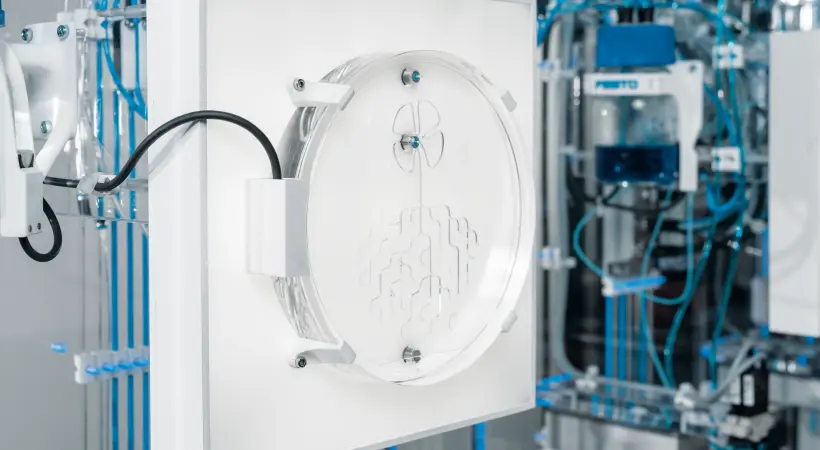
Just as in nature, capillary forces alone are not enough to carry liquid all the way to the very tip of a leaf. It can only rise slightly above the water level. While nature creates a vacuum through evaporation, we generate it in the exhibit using a precisely controlled vacuum. This draws the liquid through the bonded manifold. Using pressure-over-liquid, the system is then drained again, which creates a cycle.
High-precision dosing
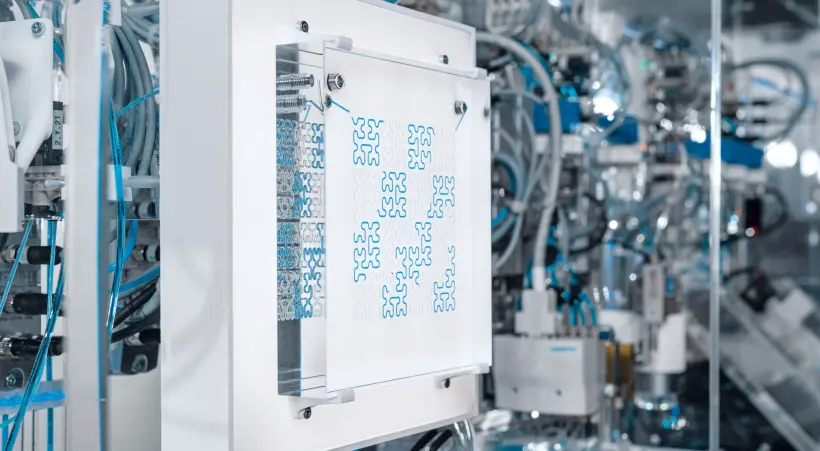
Fluids are pumped through a diffusion-bonded manifold manufactured by Festo according to a predetermined pattern via the precisely timed interaction of two media-resistant valves. This demonstrates how fluids can be dispensed with precision.
Liquid handling in the laboratory setting
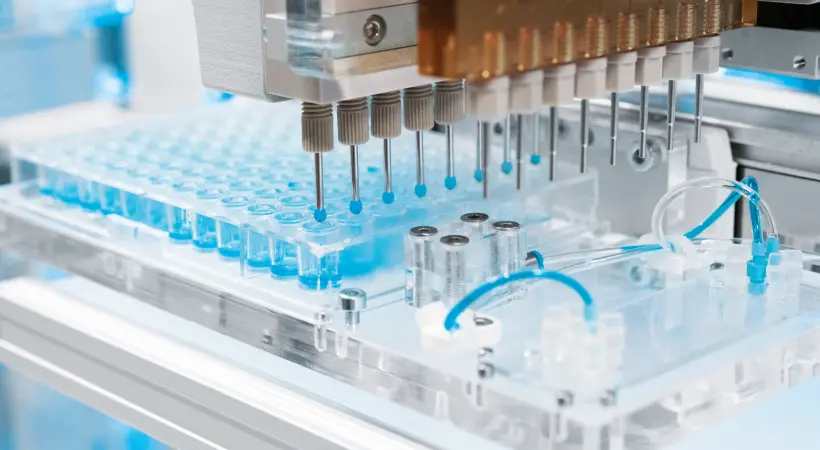
96 Samples are dispensed precisely and quickly into a microtiter plate using an eight-channel dispense head. One of these samples is then divided into a number of smaller samples using microfluidics. The process is examined under a microscope. After that, the entire system is drained again.
Sensor integration
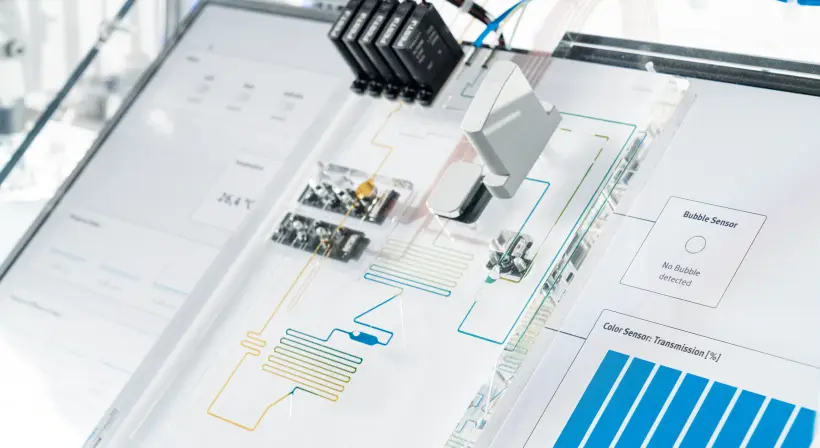
Here, Festo demonstrates how the manifold's channel structures are used for mixing and analyzing liquids. The built-in flow and pressure sensors ensure stable operation. Mixing liquids causes a color change, which is detected by optical sensors. Air bubbles deliberately injected into the system are detected and automatically removed.
Integration of pneumatic valves
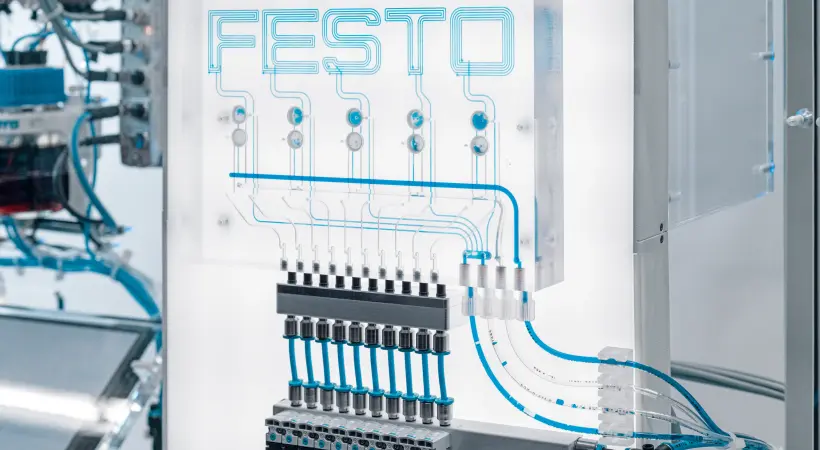
The pneumatic diaphragm valves integrated into the manifold control two different fluids, which flow to the individual letters of the Festo logo via a pressure-over-liquid system. The diaphragm valves are actuated by an external valve manifold connected via a compressed air interface.
Diffusion-bonded manifolds: Precision fluidic solutions for the most demanding applications
Diffusion bonded manifolds combine precise channel structures, a contamination-free connection of the individual layers, and a compact design. This is made possible by HADB (High Accuracy Diffusion Bonding) technology, which is used to manufacture acrylic and ULTEM manifold duct plates with the highest precision. In combination with the media-separated valves of the VYKA, VYKB, and VYKC series, Festo is able to offer microfluidic solutions from a single source.
Festo – Your automation partner for life sciences
Flexible automation solutions allow Festo to support the transition of innovative therapies into clinical practice, making state-of-the-art biotechnology available where it is needed. We offer an extensive catalog of products, but we also develop custom solutions for laboratory, diagnostic, and bioprocess applications: from precise liquid and gas dosing to scalable, modular systems. We use our product portfolio of pneumatics, electrical systems, software, and AI to work with our customers on delivering the perfect seamless automation solution.