Basic HTML Version



Festo Hungary
Between 1979 and 1990, Festo was involved in a joint
venture that developed and manufactured air preparation
units for compressed air preparation. In 1991, the auto-
mation specialist then opened its own plant. Today, it is
the central location for the manufacture of air prepara-
tion and vacuum technology products in the Festo global
manufacturing network. With a workforce approaching
800, it is set to become the fourth largest Festo plant in
2012 thanks to the huge rise in worldwide demand for
components for compressed air preparation, such as the
MS series and safety valves. Also located on the same
site is the Hungarian local sales company, which boasts an
impressive client list including Audi, Daimler, Opel and GE.
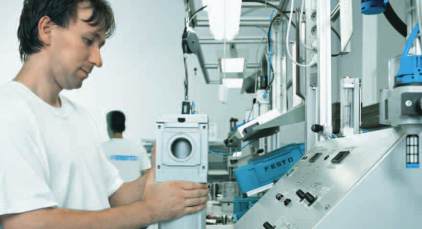
Booming MS series:
Countless variants – manufactured according to the
modular system – are made to order for customers all over the world.
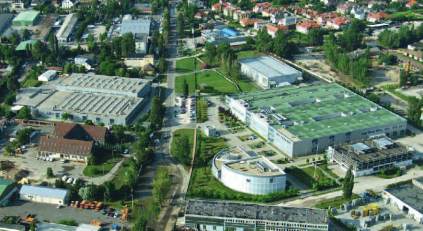
Festo in Budapest:
Local sales company for the Hungarian
market and the central plant for compressed air preparation.
H
aving once led the way in the development of the
free-market economy in Central and Eastern Europe,
Hungary was hit badly by the global economic crisis
in 2008 and 2009. The high public deficit and levels
of personal debt brought economic growth to a standstill in
2010. However, Hungary managed to weather the storm and
is now on the road to recovery. A clear indicator of this are the
high levels of investment by international groups of companies
from the vehicle manufacturing and plant construction sectors.
They are opening up new horizons for the country, with its wide
lowland plains along the banks of the Danube.
Bridge to the East
No other country in Central Europe is so closely intertwined
with other economies as Hungary. It generates 70 per cent of
its national product through exports. Numerous international
firms, most of them from Germany, invested around 60 billion
euros in recent years and currently provide almost four out of
“We redesigned the plant
so that we can respond quickly
and flexibly to changes in
the market.”
every ten jobs in the private sector. Hungary’s central location
and its close cultural and linguistic links with Germany and
Austria are crucial factors for many German-speaking com-
panies when choosing locations. The Land of the Magyar, as
Hungary describes itself, acts as a bridge to the former Eastern
Bloc countries. It offers high levels of productivity and a well-
educated and motivated workforce, many of whom speak
German and English f luently. German companies in the
automotive and plant construction sectors have taken advan-
tage of the favourable investment climate, transforming this
small country of just under 10 million inhabitants into one of
Europe’s key centres of industry in recent years. Both sectors
together currently account for more than half of the country’s
industrial production.
“Vorsprung durch Technik”
The Audi plant in the western Hungarian city of Györ is legendary.
Located halfway between Vienna and Budapest, it produced its
20 millionth engine in April 2011. Audi Hungária has been part
of the Volkswagen Group’s manufacturing network since 1993
and is the second largest company in Hungary. Automation
technology from Festo has been there right from the very start
and today ensures that the assembly plants operate efficiently.
Audi Hungária employs more than 6,000 people and develops
and produces engines for Audi AG and other makes in the Volks-
wagen Group. Every day, the plant produces 6,900 diesel and
petrol engines with between four and twelve cylinders. The
Audi TT Coupé and Roadster models as well as the A3 Cabriolet
are also assembled here. The company plans to expand the
assembly plant to incorporate the entire vehicle manufacturing
process – including press shop, body construction and paint
shop – by 2013. At around 900 million euros, this represents
the largest single investment in Hungary to date. When com-
pleted, the plant will be capable of producing 125,000 vehicles
every year, as compared with 38,000 in 2010. Audi will create
a further 1,800 jobs in the process. Combined with the new
distribution and supplier facilities, this will lead to the creation
of a total of 15,000 jobs for the people of Györ.
On the road to success
Other car makes are also discovering the potential for devel-
opment that exists in Hungary’s lowlands. Daimler AG has
invested 800 million euros in the construction of a car plant in
the southern Hungarian city of Kecskemét. Series production
of the A-Class and B-Class is scheduled to begin here in 2012.
Barnabás Bertalan,
General Manager of
Festo AM, the manu-
facturing company in
Hungary