Basic HTML Version




Imposing landmark:
The 268-metre long parliament building in Budapest.
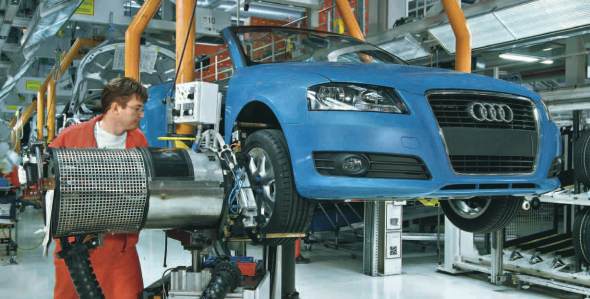
Model plant Audi Hungária:
From 2013, up to
125,000 vehicles per year will roll off the assembly
line in the 35,000 m
2
hall.
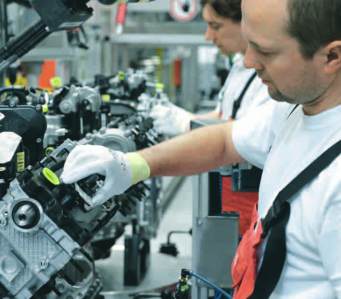
Quality from Hungary:
Not only does the engine
for the Audi TT come from Hungary, final assembly
of the vehicle also takes place here.
General Motors is spending 500 million euros on the expansion
of the Opel engine works in Szentgotthárd on the Slovenian-
Austrian border. In 2010 alone, Suzuki Hungária produced
170,000 vehicles in its plant in Esztergom, north of Budapest.
According to Germany Trade and Invest (GTAI), the economic
development agency of the Federal Republic of Germany
(www.gtai.de), Bosch and Knorr-Bremse are two of the biggest
automotive suppliers operating in Hungary, with both compa-
nies continuously putting in large sums of money. Continental
Temic, Schaeffler and ZF are also active in Hungary. Most sup-
pliers have their own local development operations. Alcoa,
Delphi, Lear, Luk, Magna-Steyr and Philips are getting in on
the act too. As part of the Daimler investment, a number of
suppliers will be setting up operations directly at the new site
in Kecskemét. The automotive industry and plant construction
sector have recognised the potential of a motivated workforce
combined with favourable economic conditions. International
groups of companies are relying on the high levels of productiv-
ity in the Hungarian economy to help them to return to stable
growth. Hungary is a small country with big opportunities.
“Our market share
of 50% shows that
we are a strong and
reliable partner for
our customers.”
Marton Szövényi-Lux,
General Manager of
Festo Hungary
1.2012
trends in automation
Synergies
28 – 29