What are organs‑on‑a‑chip?
Organ‑on‑a‑chip (OoC) refers to microfabrication processes used to create miniature models of organs such as the heart, lungs, or intestines. Cells are arranged and cultured on pre-fabricated polymer‑ or plastic substrates in such a way that they form organ-like tissues.
Fine microfluidic channels supply these cells with nutrients, oxygen or air, and generate flows and concentration gradients similar to those found in the body. This also makes it possible to simulate mechanical influences and interactions between different cell types. The result is models that provide realistic and reliable data for disease research and drug testing.
How bioprinting is changing drug testing
Medical research is constantly searching for new drugs in the fight against disease. Development of these drugs takes a long time and is very expensive. A drug candidate first undergoes several preclinical studies using cell cultures (in vitro) or animals (in vivo).
The final phase before approval involves clinical trials in humans. On average, five drug candidates are tested for each medication, four of which ultimately fail (known as late-stage failures). The reason for this is that the results of preclinical studies often do not translate well to the human body.
Much better results can be achieved using organs-on-a-chip produced by a bioprinter. These small pieces of human tissue on a microfluidic chip allow for more precise testing of efficacy and side effects in preclinical studies. This allows unsuitable candidates to be screened out at a much earlier stage. It saves time and money, allowing new drugs to be developed more quickly and at a lower cost.

"Пневматичне логічне керування відкриває нові сфери застосування повністю гнучких м'яких роботів там, де звичайні системи з електричним керуванням не спрацювали б"
Доктор Фальк Таубер, Кластер передового досвіду livMatS у Фрайбурзькому університеті
Precise fluid control for tissue engineering
In collaboration with experts from TU Darmstadt, Festo is demonstrating how the bioprinting process can be automated, including a solution for contactless transport of microfluidic chips equipped with bonded manifold technology. Multi-layer plastic‑distribution plates, with their finely structured microchannels, enable precise dispensing and handling of liquids.
SupraMotion: Contactless work in the laboratory of the future
The unique superconducting technology from Festo enables contactless transport of objects. In this process, the kinematic system remains outside the cleanroom and does not carry any particles. The smooth surfaces are easy to clean. This innovative technology can be combined with automation solutions for the life sciences sector to create a reliable, end-to-end solution that meets the most stringent requirements for cleanliness and hygiene.

“We are automating the production of organs-on-a-chip, combining two innovative technologies for the first time: SupraMotion and diffusion-bonded manifolds.”
Sebastian Schrof, Corporate Bionic Projects
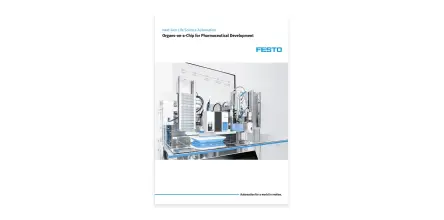
Brochure for download
Organ-on-a-chip for drug development (PDF)