What is functional safety in electric drives?
Functional safety in electric drives ensures that a motion control system reacts predictably and safely in the event of a fault or in dangerous situations. According to ISO 13849-1, safety functions are designed to reduce the risk of hazardous movements, protect operators and ensure compliance with machine safety regulations. For servo drives, this means integrating mechanisms that reliably stop, limit, or control motion when specific conditions are reached.
Why is functional safety in machine design important?
Effective functional safety helps engineers:
- Reduce the risk of injury caused by unintended movements.
- Prevent damage to machinery in the case of faults or abnormal operation.
- Comply with ISO 13849-1 requirements for performance levels.
- Simplify validation and documentation of safety-related functions.
- Build machines that are easier to commission, operate, and maintain.
How key safety functions behave in a motion control system
STO – Safe Torque Off: Immediate torque removal for a rapid safe state.
Cuts torque instantly and lets the motor passively spin down to a stop, preventing any further drive-generated movement. STO is available on all our servo drives with basic, standard, and advanced safety variants.

SBC – Safe Brake Control: Controlled braking to prevent drift or load drop.
Activates the mechanical holding brake in a safety-rated sequence after STO to stabilize vertical or suspended loads. SBC is available on servo drives with standard and advanced safety variants.

SS1 – Safe Stop 1: Controlled deceleration before switching to a safe state.
Slows down the axis in a controlled manner before torque is cut, thus reducing mechanical stress and enabling predictable stopping. SS1 is available on servo drives with standard and advanced safety variants.

SOS – Safe Operating Stop: Holds the axis safely at a controlled standstill.
Maintains the motor at a fixed position while the servo drive stays energized, enabling safe pauses and quick restarts without re‑homing. SOS is offered with advanced safety servo drives.

SS2 – Safe Stop 2: Controlled stop with energized holding for position accuracy.
Brings motion to a controlled stop like SS1 but keeps the servo drive energized to precisely hold a position for applications needing accuracy. SS2 is included on servo drives with advanced safety.

SLS – Safe Limited Speed: Prevents movements beyond a specific safe speed limit.
Continuously monitors motor speed and triggers a safe reaction if the axis exceeds the permitted limit, enabling safe setup or operator interaction. SLS is available in advanced safety servo drives.

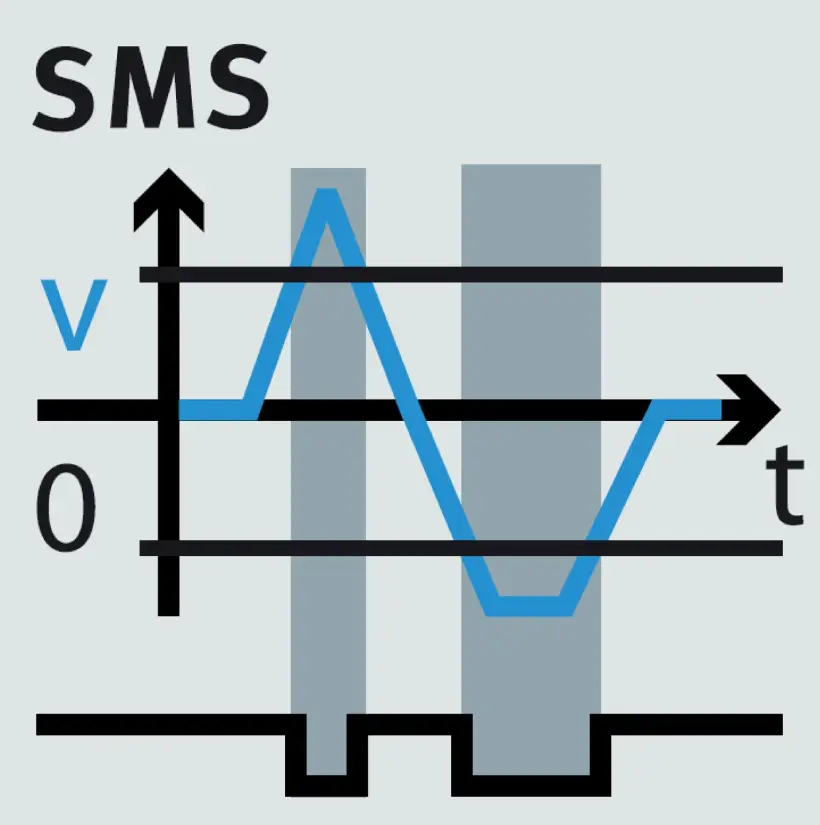
SMS – Safe Maximum Speed: Keeps motion within defined mechanical boundaries.
Controls the motor to prevent overtravel, collisions, or excessive force that could damage equipment or compromise safety. SMS is available on advanced safety servo drive variants.
FAQ – Frequently asked questions
What is functional safety in electric drives?
Functional safety ensures that an electric drive reacts predictably in a hazardous situation, whether due to a fault, unintended movement, or a triggered safety device. It reduces risks by using specific safety functions according to ISO 13849-1.
Which electric drives from Festo are certified for ISO 13849-1?
Festo offers servo drives with basic, standard, and advanced safety variants that conform to ISO 13849-1 requirements. Certification details vary by product and safety level; information about conformity can be found in the technical data for each product variant.
What safety functions are available in electric drives from Festo?
Festo servo drives support a range of safety functions to help you design safe, compliant motion sequences, with the level of safety depending on the variant.
- Basic safety (S0): STO
- Standard safety (S1): STO, SBC, SS1
- Advanced safety (S3): STO, SBC, SS1, SOS, SS2, SLS, SMS
What is Performance Level d and why does it matter?
Performance Level d (PL d) represents a high level of risk reduction in ISO 13849-1. It indicates that a safety function can reliably reduce hazards in applications with medium to high risk.
ISO 13849‑1 defines five Performance Levels, from PL a (lowest) to PL e (highest), to classify how reliably a safety function reduces risk.
Can Festo drives be integrated into existing safety systems?
Yes. Festo drives support common, safe communication networks like PROFINET/PROFIsafe; this simplifies their integration into existing machine architectures. Thanks to their all-in-one connectivity options, the drives accommodate multiple fieldbus and safety protocols without any additional hardware.
Do I need a separate safety controller for these drives?
In many applications there is no need for this, as the integrated safety functions in the servo drives can handle safety-related tasks. For more complex safety concepts, a dedicated safety controller may still be required.
Where can I get documentation or safety certificates?
Safety certificates, characteristic values, and documentation are available from the Festo website and resource libraries, including the VDMA Sistema characteristic values library. Additional information can be found in the application notes provided for each product.