




 35 / 48

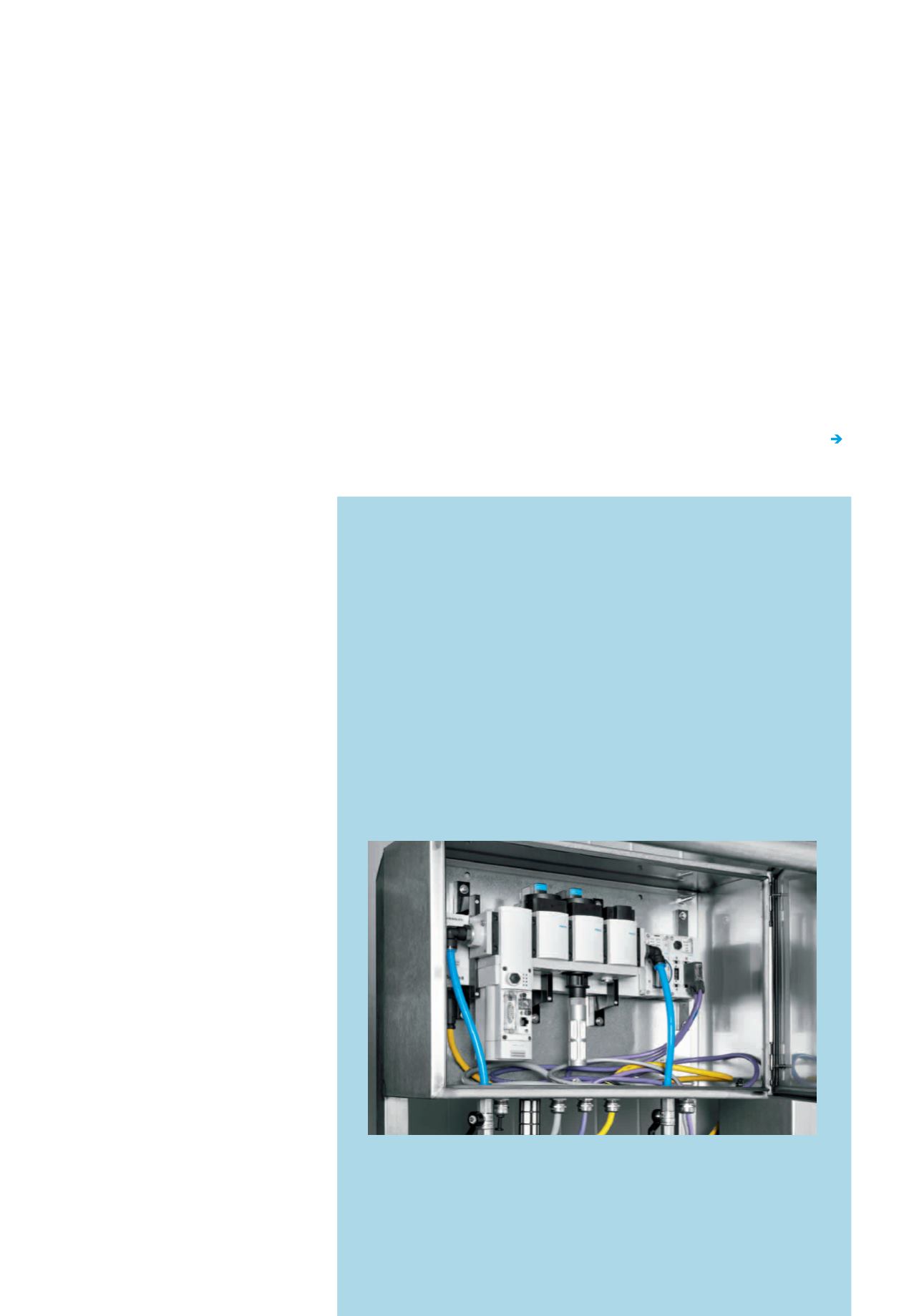
Intelligent module optimises
compressed air consumption
The energy efficiency module MSE6-E2M monitors and regulates the com-
pressed air supply in new and existing systems – fully automatically. Similar
to the start-stop system in a car, the intelligent MSE6-E2M detects a standby
mode and automatically shuts off the supply of compressed air. Compressed
air consumption is thus reduced to zero during system downtimes and breaks.
In addition, the MSE6-E2M makes it possible to measure leaks as it reports
back if the pressure drops too quickly during downtimes. Moreover, it continu-
ously delivers process-relevant data such as flow, pressure and consumption,
which it sends to the machine controller via Profibus.
Result of successful cooperation:
the first generation of the energy efficiency
module MSE6-E2M is currently in continuous operation at Unilever. The market-
ready module is around 50 per cent more compact.
I
ce cream is refreshing and with its
proteins and carbohydrates is consid-
ered a source of energy. However, it
also takes a lot of energy to mix ingre-
dients like milk, dairy chocolate, sugar
and vanilla beans into the finished prod-
uct. Electricity and compressed air play an
important role in the thermal and kinetic
processes for everything from mixing and
extruding the ingredients, deep-freezing
to -25°C, dipping into various chocolate
coatings through to final packaging. Ener-
gy efficiency is therefore right at the top
of Unilever’s list of priorities. As part of
the Unilever Sustainable Living Plan, this
global corporation has succeeded in sav-
ing more than 150 million euros in energy
costs from efficiency improvements in
production alone since 2008.
In the area of pneumatics too, the use
of innovative developments offers the
potential to save energy and thereby lower
costs. In the Unilever plant in Heppenheim,
Germany the energy efficiency module
MSE6-E2M has just recently been deployed
to reduce the compressed air consump-
tion of a plant manufacturing Magnum
ice creams. Unilever and Festo worked
together closely to get this prototype of
the energy efficiency module ready for se-
ries production. This process also showed
that it is not just in the field of energy
consumption that less is more.
Sustainability along the entire line
The Heppenheim factory is one of the
main Unilever production locations for ice
cream. These include products of the
well-known Wall’s line including Magnum,
Feast, Viennetta and Carte d’Or. High
production quantities form the basis for
supplying other parts of the European
market. Just one of the five Magnum pro-
duction lines in Heppenheim produces
more than 20,000 ice creams on a stick
per hour. This requires a lot of energy. In
order to reduce the compressed air con-
sumption of the pneumatic components,
the ability to visualise and measure the
compressed air consumption was of huge
importance to Unilever. Previously, the
consumption on the individual production
lines had not been determined. “Until then
we were just unaware,” says Alexander
Hemmerich, Automation Engineer at the
Unilever Plant, Heppenheim. “Air is not
visible, so it is not immediately obvious if
consumption is too high.” As part of the
Unilever Sustainable Living Plan there had
already been successes in other areas of
the plant. Energy-intensive geared motors
were replaced with more efficient ones,
achieving energy savings of up to 60 per
cent. Numerous 18 kW ventilators in the
cooling tunnels, which previously ran
2.2015
trends in automation
Synergies
34
–
35