




 10 / 48

autonomously on the basis of its rule
systems, but in doing so is subordinate
to the common goal and thereby plays its
part in solving the task in hand. There
is no hierarchical order. Instead, all the
BionicANTs together participate in the solu-
tion process through distributed intelli-
gence. The required information exchange
between the ants takes place via the radio
module in the torso of each individual ant.
If necessary, it is also possible to intervene
and control the interaction from outside.
Interplay of modern technologies
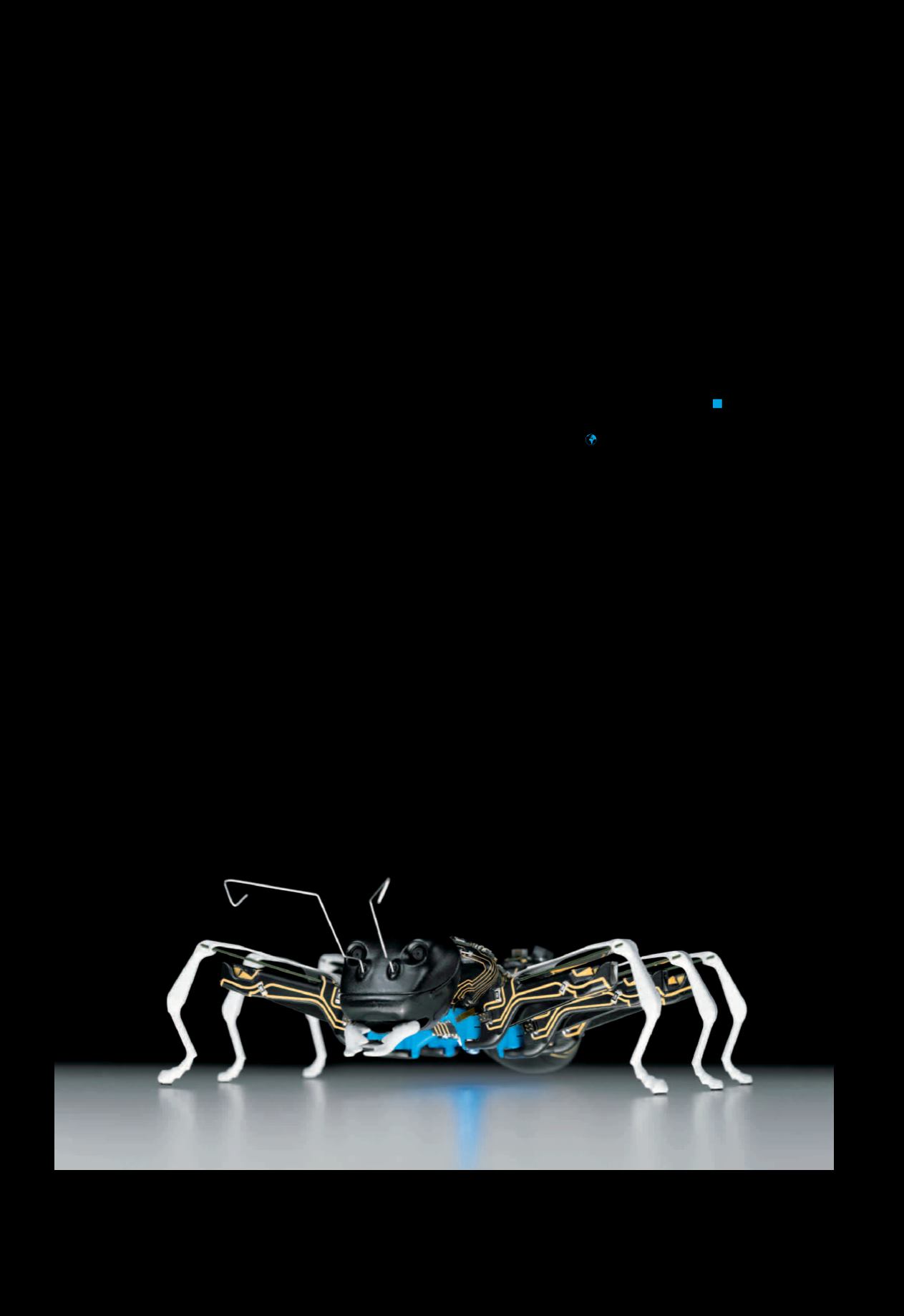
The BionicANTs are high-tech at its finest,
both inside and out. They perceive their
environment via 3D stereo cameras and
optical floor sensors. They can determine
their exact position and grasp and move
an object with their gripping tools. The
pincer movement of their jaws is produced
by two piezo-ceramic bending transduc-
ers built into the jaws as actuators. Piezo
technology also provides the BionicANTs
with their ability to move. In each of the
six thighs, there are three trimorphic,
piezo-ceramic bending transducers. This
is what enables the artificial insect to move
its legs upwards, forwards and backwards.
A huge advantage of piezo technology is
its high precision, great energy efficiency
and extremely low wear. The torsos of the
BionicANTs were laser sintered using the
SLS process and then fitted with clearly
visible conductor structures using 3D MID
technology. The electrical circuits on the
surface fulfil both design and electrical
functions simultaneously. The insects draw
their power from two batteries, which they
charge themselves via their antennae at
the charging station. A modern micropro-
cessor provides the on-board intelligence.
Real benefits for production
It does not take years for research projects
like the BionicANTs to yield real benefits.
Right now, modern technologies are
being developed, refined and modified so
that they can then serve as a template for
marketable products such as for example
the piezo-proportional valves from Festo.
They are already proving their worth a
million times over in medical technology
and in the automotive industry. Moreover,
developments like function integration,
lightweight construction, miniaturisation
Ideal platform:
research bodies for trialling new technologies.
and decentralised control technology are
being continuously integrated into actual
production. One successful example of
this is the valve terminal CPX, which can
take on condition monitoring tasks in
dependently. It will be exciting to see how
the findings yielded by bionics in the field
of cooperation between components
through communication will make their
way into production.
www.festo.com/bionicants