




 13 / 48

Integration
Miniaturisation and lightweight con-
struction – the eMotionButterflies work
as a highly complex system with reduced
materials requirements. The cleverly used
function integration together with the small-
est possible components save space and
reduce materials.
Controller
The on-board electronics allow both pairs of wings
to be accurately controlled. The flight behaviour is
controlled by the electronics’ own inertial sensor sys-
tem. Using the two servomotors, the wing amplitude,
wing speed and the respective turning points can
be freely and individually selected. This makes the
eMotionButterflies fully manoeuvrable, very agile
and extremely similar to their biological role model.
The knowledge gained from the projects on the
BionicOpter and the eMotionSpheres was
channelled into the control system for
the artificial butterflies.
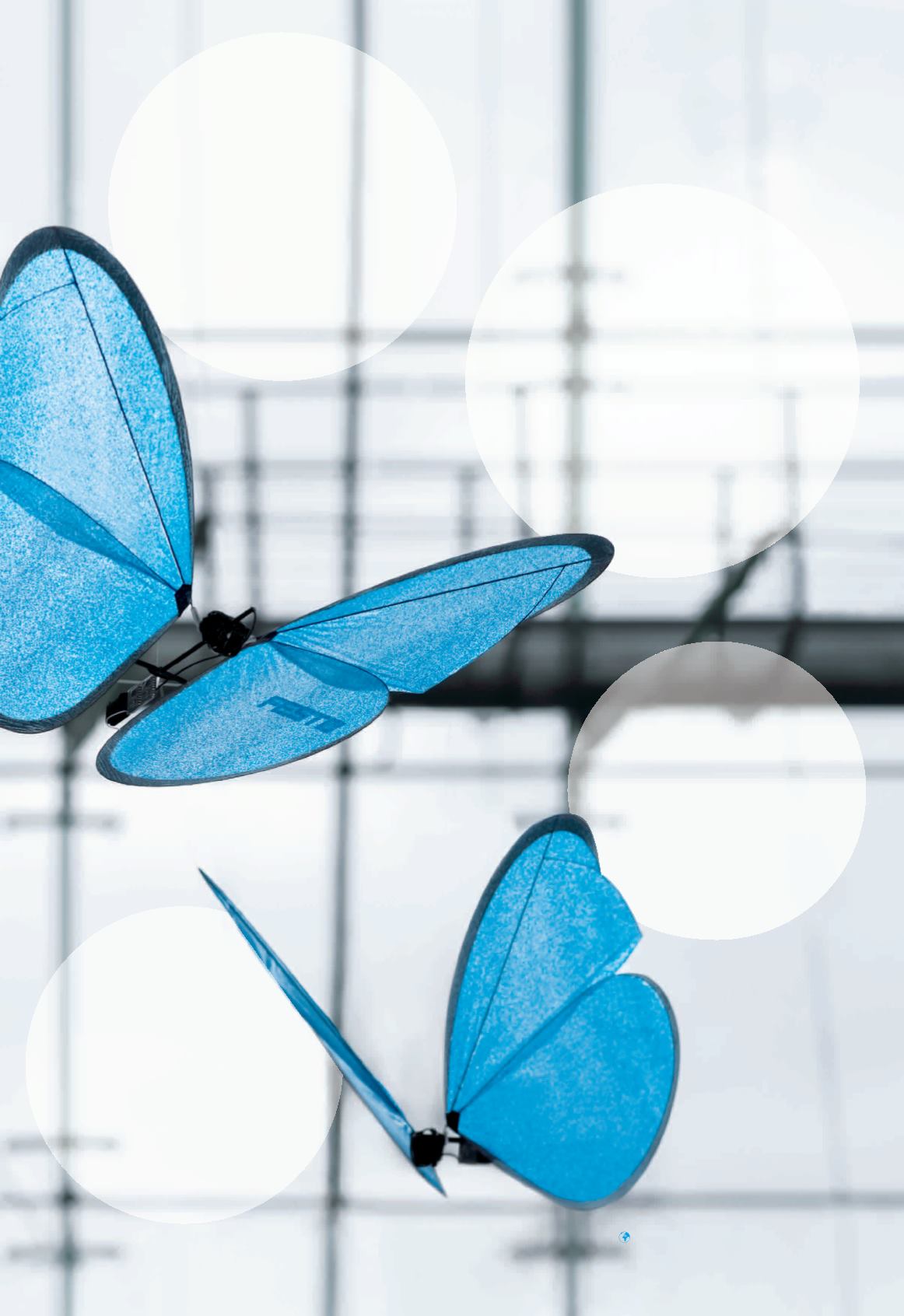
Lightweight construction
50 cm wide, weighing only 32 g:
the gossamer-light aerodynamic slotted
wings of the eMotionButterflies comprise
wafer-thin carbon rods covered with an
elastic capacitor film.
Motion
The laser sintered torsos of the artificial
butterflies contain everything necessary for
movement: electronics, battery and two servo
motors. The front and rear wings are connected
directly to the motors via wing roots. The rear wing
is also attached to the torso using a hinge and thus
essentially acts as a tail unit. An air gap between
the slightly overlapping wings gives the butter-
flies the aerodynamics they need.
www.festo.com/emotionbutterflies2.2015
trends in automation
Compass
12
–
13