



 9 / 48

T
he formicidae insect family has
a number of advantages over
humans. With a development his-
tory that spans 130 million years,
ants are a good 128 million years older as
a species. The number of their individuals
and their global biomass far exceeds that
of people. Ants can carry many times their
own body weight and can survive both at
-40 °C and in extreme desert climates.
But the most amazing thing about them is
that they live in colonies of up to 20 mil-
lion insects on the basis of collective, not
individual intelligence. Communication
between ants takes place via scents,
so-called pheromones. The way they live
and work together on the basis of collec-
tive intelligence made them an excellent
model for the researchers at Festo’s Bionic
Learning Network for a bionic technologi-
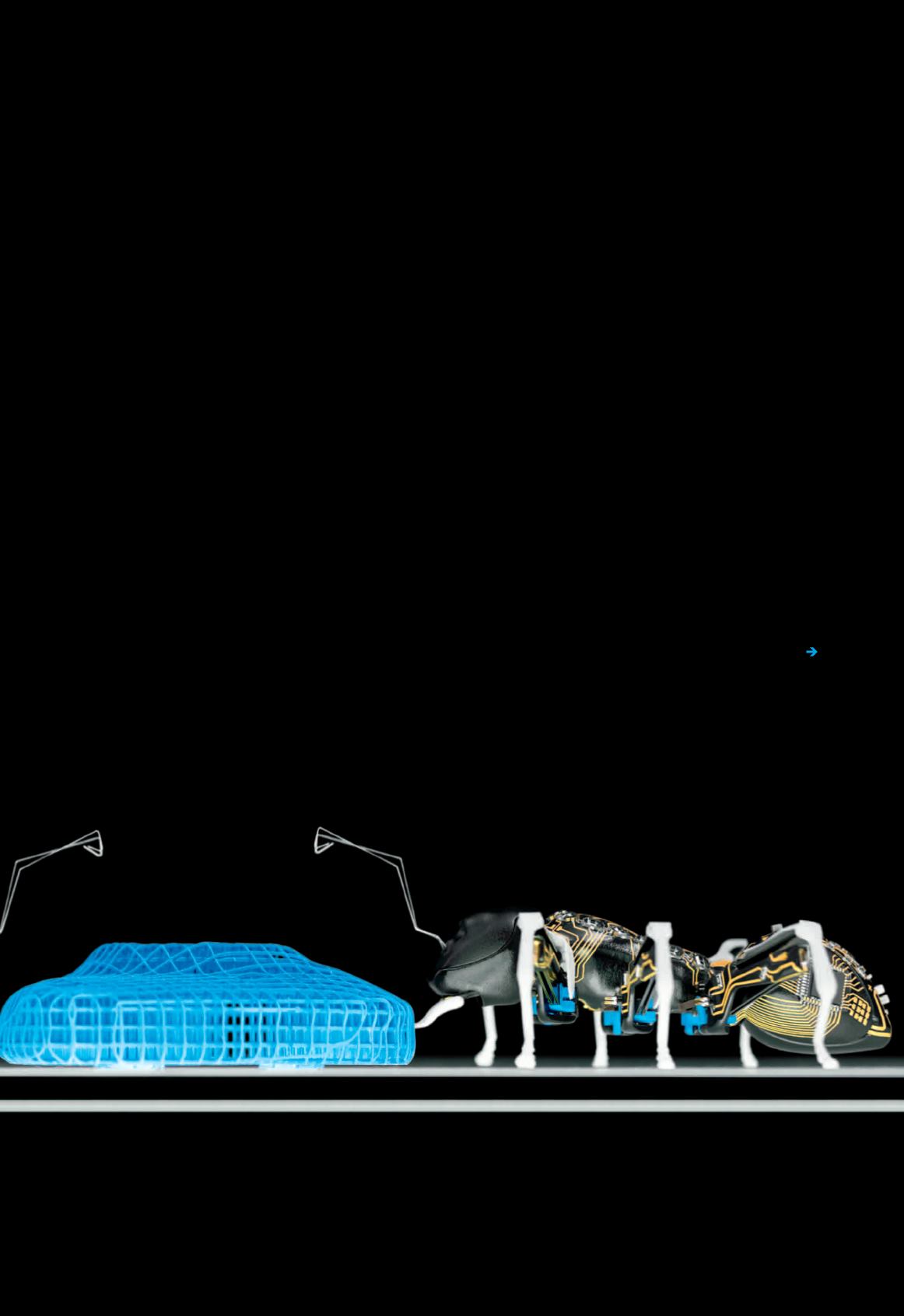
cal showpiece: the BionicANTS. “ANT
”
here stands both for the insect inspiration
and for Autonomous Networking Technol-
ogies. The little six-legged creatures from
the Festo research laboratories make their
decisions autonomously on the basis of
complex control algorithms for cooperative
behaviour. Created for team work, they
strive towards a common goal without the
influence of a central intelligence, such as
that of a computer.
Ants as a template for the future
Before taking a look at the detailed tech-
nical solutions used in the BionicANTs,
a brief excursion into the future of pro-
duction explains what makes today’s
bionic ants so important. In a few years’
time, individual production components
will utilise a system similar to that of the
ants and work together on a project with
a high degree of flexibility. The background
to this is the global trend towards the
production of more customised products.
Small batch quantities and a large number
of variants demand technologies that
adapt themselves intelligently to changing
conditions. Components in the industrial
systems of the future will have to be cap
able of adjusting to one another. Tasks
that are currently still performed by a cen-
tral computer, will be taken over by the
interplay of individual components in the
future.
Acting independently and in a network
The BionicANTs show how individual
units can react independently to different
situations, coordinate with one another
and act as a networked, complete system.
By doing this, the artificial ants push
and pull an object with their combined
strength over a marked-out surface.
Thanks to intelligent division of labour,
they efficiently move loads that an indi-
vidual ant could not move on its own. Like
their role models from the natural world,
the BionicANTs work together according
to clearly defined rules. They communi-
cate with one another via radio and coor-
dinate their actions and movements. Each
individual ant makes its decisions
2.2015
trends in automation
Compass
8
–
9