




 19 / 48

training and qualifications will become a critical success
factor, much more so than they are today. In networked pro-
duction, we need the ability to work in an interdisciplinary
way, we need a culture of learning.
Can you give us an example of what you mean?
Veit:
Think of the profile of a mechatronics engineer: it com-
bines mechanical, electronic and IT elements – so precisely
the interdisciplinary knowledge that we need in the factory
of tomorrow. In general, engineers increasingly require
know-how in the field of IT, while IT specialists must adjust
more and more to the needs of the engineering environment.
Software development, electronic engineering and hardware
development are joining forces with machine and system
engineering – Festo is a pioneer in this field.
So employee qualifications will become increasingly
important. What does that mean for companies?
What prerequisites must they meet?
Veit:
Industry 4.0 will bring about very different develop-
ments for companies and their employees. What these will
be precisely only the future will tell – one thing is for sure,
the offer in terms of training and further education must be
adjusted to suit. Because excellent Research & Development
resources and the availability of skilled staff are more im-
portant than ever if we are to ensure the future viability of
companies at a global competitive level. Our subsidiary
Festo Didactic takes this into account both with its teaching
and research platforms like the cyber-physical factory
and with its range of seminars for Industry 4.0. In our
Scharnhausen technology plant too, learning plays a key
role. We have integrated our own learning factory there so
“People are, and will remain,
an indispensable part of the
world of future production.”
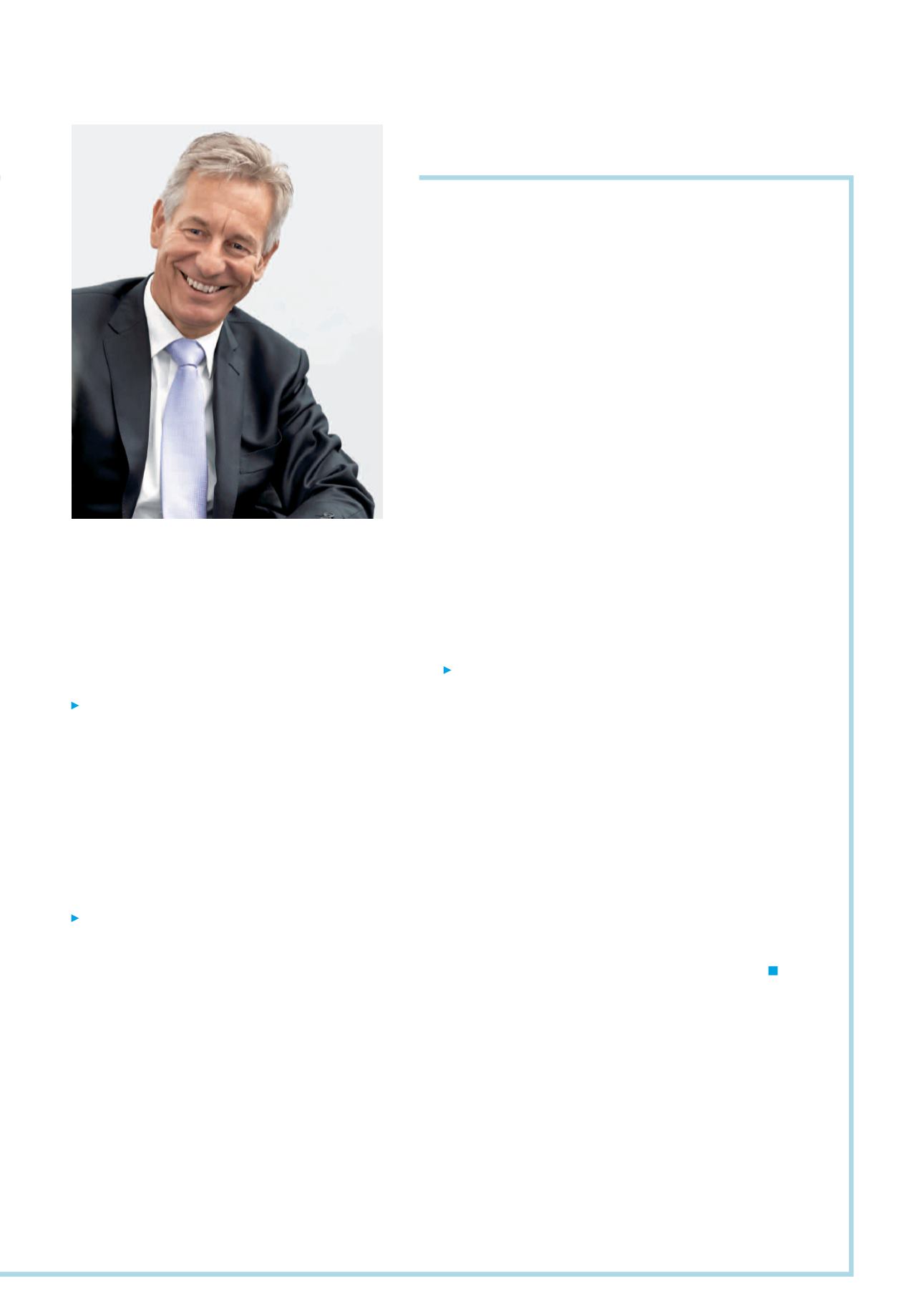
Dr. Eberhard Veit, Chairman of the Management Board of Festo AG
that we have a direct and practical way of passing on
training content on site.
When you talk about Industry 4.0, what time frame are
you envisaging: 10, 20, 30 years? And is this even a process
that can achieve a clearly definable goal or is this an open-
ended development into the future?
Veit:
For Festo, Industry 4.0 is a highly interdisciplinary
future project on which we will continue to work. In our view,
the automation pyramid will change in an evolutionary way:
functions from the higher levels will move down. In the com-
ing years, the first industrial transformations that we can
expect to see are in the field of comprehensive energy man-
agement and condition monitoring. What is important is that
we deliberately tackle in particular those work areas where
there is still a great need for action, for example IT security
and standardisation processes. To sum up, Industry 4.0 is a
development process which will still require a long time to be
fully implemented. With the work of the Industry 4.0 Platform
and its predecessor we are making excellent progress.
2.2015
trends in automation
Impulse
18
–
19