



 28 / 48

(B)
(C)
Diverse economy
The Danish krone has been Denmark’s official currency
since 1875. It has been pegged to the euro since the
latter’s introduction. The country’s economic landscape
is characterised by a large number of medium-sized indus-
trial firms and service providers. Internationally recog-
nised names include Novo Nordisk, Bang & Olufsen,
Vestas, Grundfos, Ecco, Lego and Rockwool. Denmark’s
large-scale global players include shipping company A.P.
Møller-Mærsk, food producer Arla Foods and Carlsberg,
the fourth largest brewery group in the world. The machine
and plant building, pharmaceutical and tourism sectors
are also major contributors to the Danish economy. Given
the importance of the social welfare system in Denmark,
around 30 per cent of the workforce is employed in the
public sector. Exports account for around one third of Den-
mark’s GDP. Chief exports include machinery and machine
parts, food, pharmaceuticals and electronics. In the wake
of the global economic crisis, Denmark returned to eco-
nomic growth in 2011. In 2014, GDP grew by around 0.8 per
cent and the Danish Foreign Ministry expects growth of
around 1.3 per cent for 2015.
Design and architecture
Two areas in which the Danes create a good impression in
the truest sense of the word are architecture and design.
Denmark boasts a number of internationally renowned
architects including Jörgen Utzon, who designed the Sydney
Opera House, and Henning Larsen. Verner Panton, famous
for the Panton Chair, Arne Jacobsen, Hans J. Wegner, Paul
Kjærholm and Poul Henningsen are pioneering figures in
the world of design. Industrial design, high-quality furniture
and a wide range of products featuring innovative design
have been some of Denmark’s leading exports for many
years. Design is a key element of the Danes’ national iden-
tity as well as their everyday lives.
Focus on research
The Danish government invests heavily in research and
development. At 3.0 per cent of its GDP, Denmark ranks 6th
in the list of OECD countries. Key areas of research include
life and agricultural sciences, information and communica-
tion technology as well as environment, climate and ener-
gy. In its ‘Research 2020’ agenda, Denmark has identified
five key research visions: a society with a green economy,
a society in good health and with a good quality of life, a
high-tech society with innovation capacity, an efficient and
competitive society and a well-educated, competent, cohe-
sive society. Denmark is a European leader in the field of
life sciences.
A nation powered by the wind
The growth of renewable energy in Denmark has been
driven by two factors: an environmentally friendly, sustain-
able lifestyle and an average wind speed of 7.6 metres per
second, or 27.36 km/h. In 2014, 5,200 wind turbines met
around 39 per cent of the country’s electricity needs. Den-
mark aims to increase this figure to 50 per cent by 2020.
By 2035, more than 80 per cent of the country’s electricity
will be provided by wind power. A foretaste of the potential
offered by wind power was witnessed on 9 July 2015. On
this very windy day, Danish wind turbines were able to
deliver 116 per cent of the country’s total energy needs
during the day and 140 per cent at night.
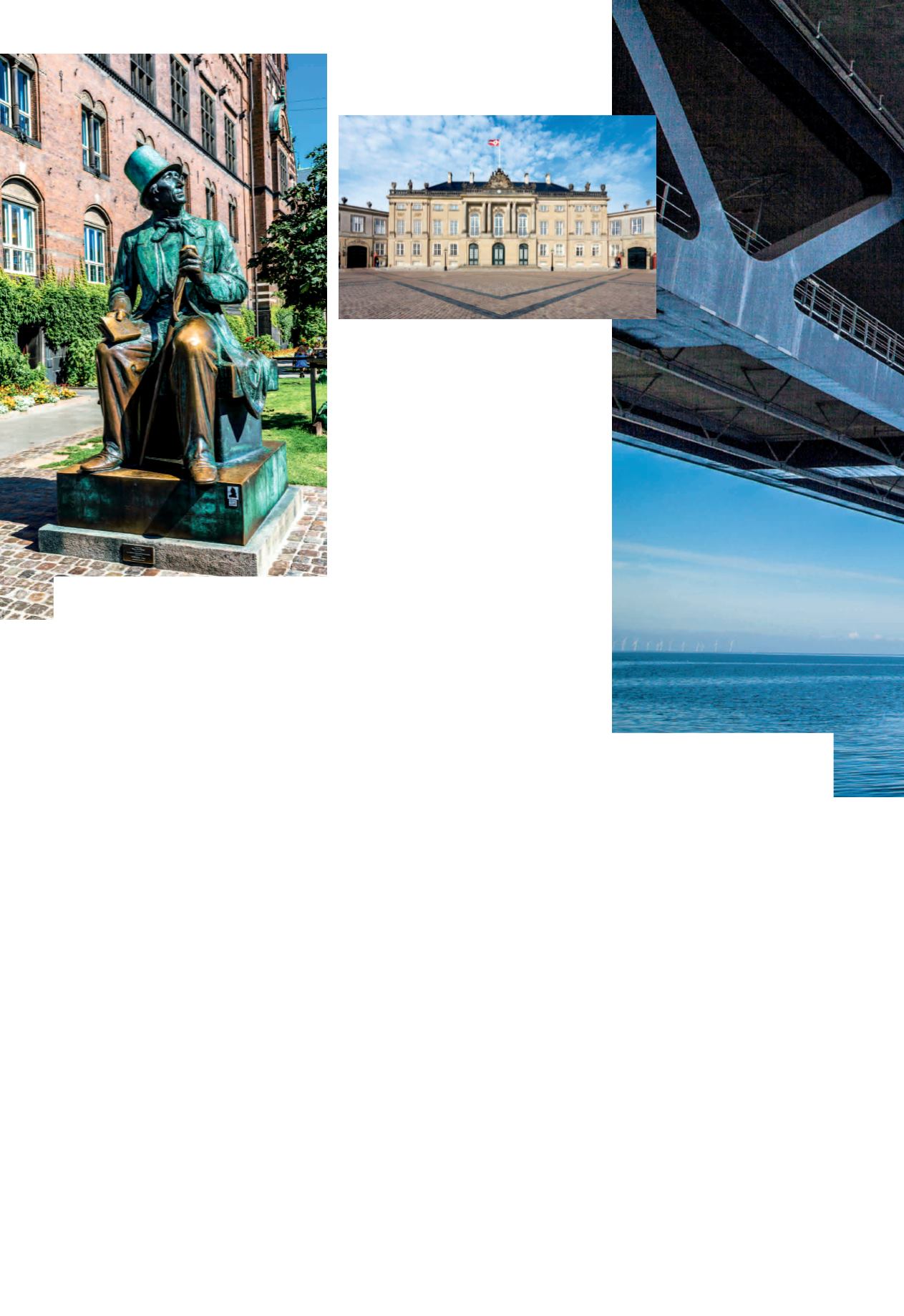
(C) The Øresund Bridge:
the world’s longest
cable-stayed bridge for combined road and
railway transport connects Copenhagen and
the Swedish city of Malmö.
(A) Hans Christian Andersen:
Denmark’s most
famous poet and writer. His works such as
‘The Princess and the Pea’, ‘The Snow Queen’
and ‘The Little Mermaid’ have been translated
into more than 120 languages.
(B) Amalienborg Palace:
The city residence of
the Danish queen dates from the 17th century.
(A)