Meet the new standard for process automation education and training laboratories.
The DCS Learning System – SIMATIC PCS neo is an interactive, networked training unit that provides all the tools—hardware, software, and courseware—needed to deliver hands-on instruction in process control and instrumentation, from basic to advanced levels, through real DCS interactions.
It is ideal for preparing career-ready process operators, technicians, engineers, and electrical and instrumentation (E&I) technicians at school, or for upskilling industry professionals.
System highlights
- Single- and multivariable process loops (flow, level, pressure, temperature)
- Supports cascade and advanced interacting loop control strategies
- Smart field devices and high-quality industrial components
- Two process media: liquid and gas
- Batch control and recipe management
- Industrial Internet of Things (IIoT) connectivity and networking
- Remote access for system monitoring and control
- Can be used as an Operator Training System (OTS)
System description: Equip your laboratory with cutting-edge training equipment
The rugged workstation is built for intensive hands-on experimentation, with stainless steel piping and concealed wiring for added durability.
Workstation equipment
- Large touch panel display
- Stainless steel piping
- Water tank
- Two acrylic columns
- Two centrifugal pumps with variable-frequency drives
- Valves: ball valves, globe valve, check valve, pneumatic actuator globe valve, proportional pressure control valve, solenoid valve, angle-seat control valve with pneumatic actuator
- Over 20 pressure measurement ports
- Manometer and rotameter for flow and pressure monitoring
- Electrical and control components housed in a rear cabinet
Smart field instrumentation
- Pressure switch
- Differential pressure transmitter (high-range)
- Temperature transmitter (Pt100 RTD)
- Temperature transmitter (J-type thermocouple)
- Magnetic flow transmitter
- Radar level transmitter with remote display
- Differential pressure transmitter with 3-valve manifold (flow, Venturi)
- Differential pressure transmitter (level, low-range)
Learning objectives: Close skills gaps in process automation education
Provide essential hands-on instrumentation and process control experience via a DCS through:
- Structured hands-on labs covering calibration, configuration, commissioning, and operation of a distributed control system
- Core process fundamentals, including key process variables, system dynamics, centrifugal pumps, and fluid mechanics
- Instrumentation & control: identifying, configuring, and calibrating primary measuring devices and final control elements
- Industrial communication: setting up and troubleshooting HART, Modbus, and common industrial networks
- Process control & optimization: tuning control loops, managing alarms, and optimizing process performance
- Process simulations and operator shadowing to connect measurements, control actions, and real process outcomes
- Troubleshooting scenarios with staged electrical, instrumentation, and process faults under time pressure, including root-cause analysis
- Documentation & communication exercises, such as reading piping and instrumentation diagrams (P&IDs), writing shift logs, creating concise fault reports, and performing handovers
Topic coverage: Level up your teaching with our pre-built course content
Build tailored learning paths while saving time: The ready-to-use course “DCS Learning System (PCS neo)” provides a rich pool of teaching and learning material with comprehensive topic coverage. Discover the course outline:
Learning Unit 1 — Process Control Systems
- Key topics: DCS (SIMATIC PCS Neo) overview, process variables, operations, DCS vs PLC, DCS architecture, P&ID, standards, HMI (menus, alarms, emergency), communication networks, sequencers (Levels, Batch), start-up & shutdown procedures.
- Experiments: Exercise 1‑1 — Introduction to the DCS Learning System (SIMATIC PCS Neo): HMI navigation, alarms, levels sequencer, batch sequencer, start/stop sequences.
Learning Unit 2 — Introduction to Measurement
- Key topics: fundamentals of measurement, units, observable variables, instrument characteristics (accuracy, precision, errors), loop error, dynamic characteristics, dead time, response curves, time constant.
Learning Unit 3 — Pressure Measurement
- Key topics: fluid properties, hydrostatic pressure, Pascal’s law, pressure units, static pressure head.
- Exercises: Exercise 3‑1 — Pressure Sensing Devices: manometers, Bourdon tube gauges, strain-gauge transmitters, pressure switches, installation & bleeding, pressure measurement in piping and pump systems, digital pressure switches.
Learning Unit 4 — Introduction to Flow
- Key topics: volume flow rate, mass flow rate, fundamentals of flow measurement.
- Exercises: Exercise 4‑1 — Rotameters: design, reading technique, pros & cons, flow measurement with rotameters.
Learning Unit 5 — Pressure Versus Flow
- Key topics: fluid dynamics, Bernoulli equation & applications, laminar vs turbulent flow, Reynolds number, pressure types.
- Exercises: Exercise 5‑1 — Centrifugal Pumps: pump types, operation, performance curves, cavitation, NPSH, head vs speed; Exercise 5‑2 — Pressure Loss: major/minor losses, K-factor and equivalent length methods; Exercise 5‑3 — Control Valves: solenoid & proportional valves, valve characteristics, pneumatic actuators, positioners, valve sizing & commissioning.
Learning Unit 6 — Flow Measurement
- Key topics: primary flow elements (orifice plates, Pitot tubes), differential-pressure fundamentals.
- Exercises: Exercise 6‑1 — Venturi Flow Elements & Electromagnetic Flow Meters: Venturi operation, flow calculations, installation, pressure loss; electromagnetic meter principles, commissioning, advantages/limitations, manifold operation for DP transmitters.
Learning Unit 7 — Level Measurement
- Key topics: level measurement principles, hydrostatic level, suppressed/elevated zero ranges, differential pressure for level.
- Exercises: Exercise 7‑1 — Differential Pressure Level Meters: configuration, zeroing, level in pressurized vessels; Exercise 7‑2 — Radar Level Meters: guided vs non‑guided radar, echo analysis, dielectric effects, linearization, mapping, commissioning, volume readings.
Learning Unit 8 — Temperature Measurement & Heat Transfer
- Key topics: temperature scales, thermodynamics, heat transfer mechanisms (conduction, convection, radiation), specific & latent heat.
- Exercises: Exercise 8‑1 — Temperature Probes: RTDs, thermocouples, wiring, noise sensitivity, transmitters, time-constant measurements.
Learning Unit 9 — Process Characteristics
- Key topics: open-loop vs closed-loop, dynamic systems, block diagrams, process dynamics (resistance, capacitance, inertia), single‑capacitance models, time constant, process gain.
- Exercises: Exercise 9‑1 — Determining Dynamic Characteristics of a Process: open-loop response analysis, process order/gain, graphical and numerical methods (2%–63.2%, 28.3%–63.2%), pressure process characterization.
Learning Unit 10 — Feedback Control
- Key topics: feedback fundamentals, on‑off control, PID control (P, PI, PID), controller tuning, controller structures (parallel, interacting, non‑interacting), effects of controller actions.
- Exercises: Exercise 10‑1 — Tuning and Control of a Pressure Loop: trial-and-error tuning, P/PI modes; Exercise 10‑2 — Tuning and Control of a Flow Loop: ultimate cycle tuning, Q‑decay; Exercise 10‑3 — Tuning and Control of a Level Loop: open-loop Ziegler‑Nichols, fine tuning; Exercise 10‑4 — Cascade Control of a Level/Flow Process: cascade setup and tuning.
Learning Unit 11 — Batch Control
- Key topics: batch process control concepts, functions, standards, batch vs continuous processes, optimization.
- Exercises: Exercise 11‑1 — Tuning a Batch Control System: batch loop control and parameter tuning.
Learning Unit 12 — Troubleshooting of a Process Control System
- Key topics: systematic troubleshooting, 7‑step method, plant shutdown scenarios, guided vs non‑guided troubleshooting, projects and transversal skills.
- Exercises: Exercise 12‑1 — Guided Process Control Troubleshooting; Exercise 12‑2 — Non‑Guided Process Control Troubleshooting and project work.
Simplify DCS training with SIMATIC PCS neo.
SIMATIC PCS neo, Siemens’ next-generation DCS aligned with Industry 4.0 requirements, offers the right balance of industrial realism and educational usability. Learners gain practical skills—process monitoring, alarm handling, control strategies, and diagnostics—that are transferable to other DCS environments.
PCS neo offers key advantages:
- Browser-based access – no software installation required
- Remote system monitoring and operation – accessible even outside lab hours
- User-friendly interfaces – suitable for beginners
- Data visualization and simulation/testing tools
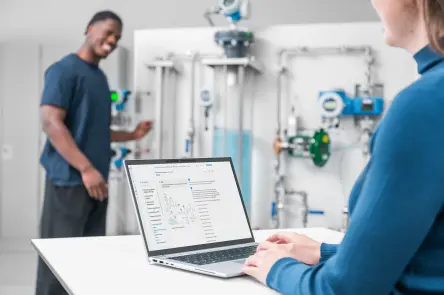
Expedite curriculum updates with DCS course materials.
Ready-to-use teaching and learning material—available digitally on Festo LX or as workbooks—provides clear guidance on essential topics, targeted skills, and relevant learning objectives. Select the theory and hands-on lab experiments that best fit your learners’ needs.
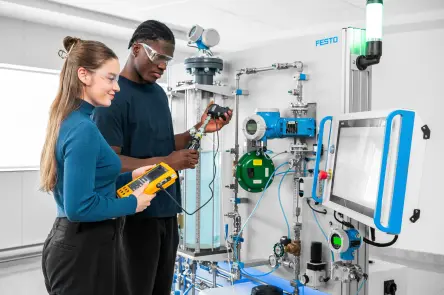
Roll the system into the lab and start immediately.
All components are installed and wired, and the software comes preloaded. Preprogrammed flow paths, batch sequences, a fixed equipment layout, and ready-to-run exercises ensure smooth commissioning and efficient lab sessions.
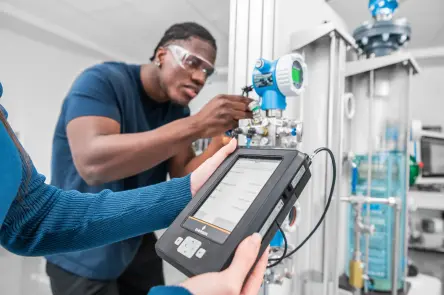
Put troubleshooting skills to the test.
Teachers can introduce faults—calibration errors, broken wires, and other common issues—directly from the HMI or remotely, while learners are actively working on the workstation. This allows learners to analyze alarms, diagnose issues, and apply corrective actions.
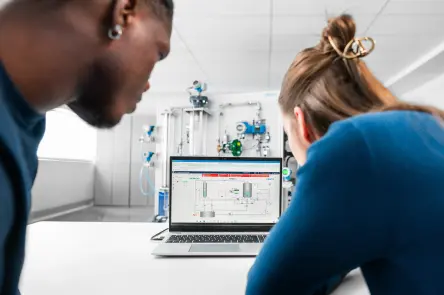
Prepare workers for multiple industries.
With a curated selection of smart field devices, device networking with common industrial communication protocols, and a dual-media design, the system equips learners for fast-growing sectors—such as semiconductors, hydrogen, batteries, water technology, and chemicals—where advanced automation and digitalization are standard.

Not quite sure yet?
Festo is a trusted provider of hands-on industrial automation learning solutions. Browse our catalog to explore our full range of process automation learning systems. You might be especially interested in:
You can also read our series of articles on trending topics shaping skill requirements in process automation education.
Download the product catalog (PDF)